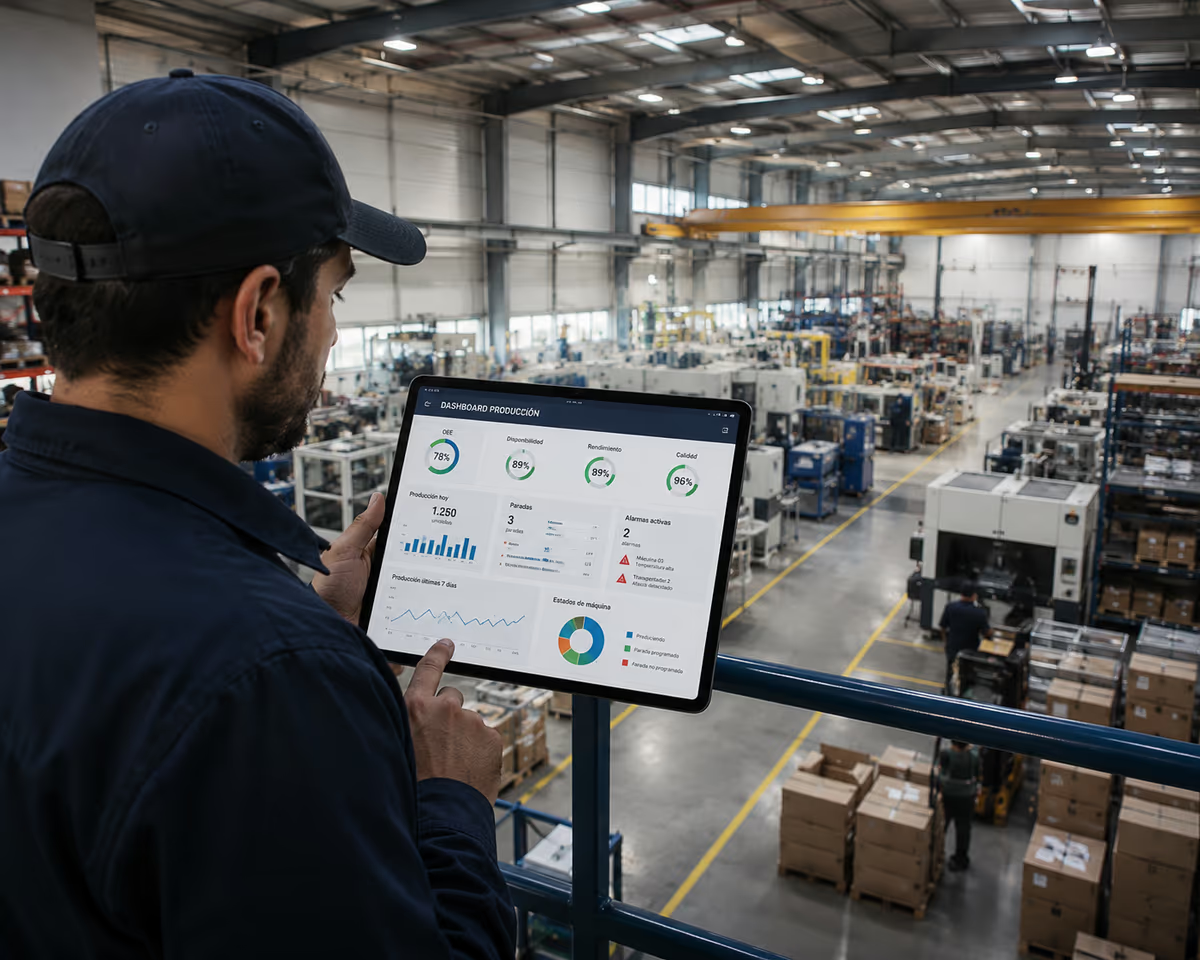
SCADA for SMEs: when it pays off and what it costs
· by Panayot Dimkov
A SCADA for SMEs is no longer a big-factory luxury: it is the difference between knowing what happened on your line at 3 a.m. and finding out from the next morning's shift report. In this guide we answer the question with an integrator's judgement: when it pays off, what an entry-level project costs, what it includes and which mistakes to avoid.
Does a SCADA make sense in a small industrial company?
Direct answer: yes, from around 20–30 relevant signals, or as soon as traceability or quality demand it. That is the threshold we see repeated across Nexum Automatics projects: below it, a well-designed HMI on the machine itself is usually enough; above it, the cost of not having data — hours of manual logging, unexplained stoppages, customer claims with no records to defend you — exceeds the cost of the system. And the system costs less than most people assume: an entry-level SCADA project for an SME runs roughly €15,000–40,000 turnkey, based on our experience as integrators.
What do we mean by a "relevant signal"? Not every input wired into a PLC, but every value someone actually needs in order to run or defend production: line counters, machine states and stoppage causes, critical process temperatures and pressures, energy meters, quality checkpoints. A modest packaging line can easily justify 25 such signals; a workshop with one manual machine cannot — and that honest count, not the size of the company, is what decides the question.
The second trigger is external: when an automotive or food-industry customer asks for batch traceability, when a quality audit requires process records signed by the system rather than by a person, or when you work under standards that demand parameter histories (pasteurisation temperatures, tightening torques, sterilisation curves). At that point the SCADA stops being an improvement and becomes a commercial requirement.
Signs your plant needs a SCADA
More useful than theory: go through this list. With three or more items ticked, the project usually pays back in under two years.
- Handwritten production reports: operators noting counters, temperatures or weights on paper or Excel at the end of the shift.
- Stoppages with no recorded cause: you know the line stopped, but not for how long, how often or why — impossible to calculate a credible OEE.
- Customers or audits demanding traceability: batches, process parameters, CIP cleaning records, electronic signatures.
- Several isolated PLCs: machines from different manufacturers that do not talk to each other, each with its own screen and captive data.
- Alarms only visible at the machine: the weekend fault is discovered on Monday; nobody was notified.
- Energy consumption in the dark: one electricity bill for the whole plant, with no idea which line or shift drives the cost.
- Recipes tuned "by ear": the good parameters live in the senior operator's head, not in a recipe system.
If what holds you back is headcount — "we have nobody to watch screens" — the logic is exactly the reverse: a SCADA is one of the levers to grow in competitiveness without growing headcount, because it turns supervision into an exception (alarms and notifications) instead of permanent surveillance.
Entry-level SCADA vs. corporate platform
Most budget shocks come from comparing different things. An SME SCADA and a corporate platform share a name, not a project:
| Aspect | Entry-level SCADA (SME) | Corporate platform |
|---|---|---|
| Scope | One line or a small plant | Multi-plant, multi-site, hundreds of users |
| Typical signals | 50–300 | Thousands to tens of thousands |
| Architecture | One local server + client stations | Redundant servers, dedicated historian, DMZ |
| Integration | Existing PLCs, basic reporting | MES, ERP, laboratory, maintenance (CMMS) |
| Timeline | 4–10 weeks | 6–18 months |
| Indicative budget | €15,000–40,000 | €100,000+ |
The good news: current platforms (Ignition, WinCC Unified, Citect, AVEVA, B&R, Movicon…) scale by licence, so starting at entry level does not mortgage the future if the architecture is designed sensibly: an orderly signal naming convention, a server sized with headroom and standard protocols (OPC UA, Modbus TCP, Profinet). The fine-grained breakdown of licences and engineering is in how much a SCADA system costs.
What an SME SCADA project includes: the 5 phases
A well-run project is short but complete. This is how we structure it in our SCADA systems service:
One nuance we always stress: the item that generates the most value is not the pretty screens, it is phase 1. A SCADA capturing the right 40 signals is worth more than one capturing 400 irrelevant ones. And plan for life after go-live from the start: an annual support budget of a few days of engineering keeps reports aligned with how the plant actually evolves, which is what separates systems still in daily use five years later from those quietly abandoned.
Typical beginner mistakes (and how to avoid them)
Grants for digitalisation: Kit Digital and EU funds
The investment rarely has to be carried alone. Plant digitalisation has historically fitted two routes in Spain: the Kit Digital programme, aimed at digitalisation solutions for SMEs, and the industrial calls linked to the EU Recovery Plan (PRTR) and connected-industry programmes, on top of regional Industry 4.0 schemes. Amounts and requirements change with every call, so the correct order is: define the project first, then — technical brief in hand — check which open grant fits. The full map is in EU funding for industrial automation.
Frequently asked questions
Does a SCADA make sense in a small industrial company?
Yes. In Nexum Automatics' experience, a SCADA starts paying off from around 20–30 relevant signals, or as soon as a customer or a standard requires process traceability. Below that, a well-designed HMI is usually enough; above it, logging data by hand costs more than the system.
How much does a SCADA cost for an SME?
An entry-level SCADA project for an SME — one line or a small plant, in the order of 50 to 300 signals — runs roughly between €15,000 and €40,000 turnkey in Nexum Automatics' experience: licences, engineering, integration with existing PLCs, screens and training. Corporate multi-site platforms play in a different budget league.
What is the difference between an entry-level SCADA and a corporate platform?
An entry-level SCADA supervises one line or plant with signal-limited licences, a local server and standard screens, and is deployed in weeks. A corporate platform adds redundancy, long-term historians, MES/ERP integration and multi-site architecture, with budgets and timelines several times larger. For most SMEs, starting small and scaling is the sensible route.
Are there grants for implementing a SCADA in an SME?
Yes. Plant digitalisation has historically fitted programmes such as Spain's Kit Digital and industrial calls linked to the EU Recovery Plan (PRTR), plus regional Industry 4.0 schemes. Calls change every year, so check the ones currently open before signing the project.
The bottom line
A SCADA for SMEs pays off sooner than it seems: from around 20–30 signals, or from the first customer who demands traceability. With €15,000–40,000 well invested — signal list first, licences second — a small plant moves from running on memory to running on data, and the architecture is ready to scale without throwing anything away.
See how we approach it in our SCADA systems service.
Is your plant already showing the signs?
Tell us which machines you have and which data you are missing. We will propose the entry-level SCADA that fits, with a fixed quote and the current grants reviewed.
Request an assessmentNexum Blog
Related articles

10 Apr 2026
Industrial Automation in Madrid: The Complete Guide 2026
Comprehensive Guide to Industrial Automation in Madrid: SCADA, Robotics, Electrical Panels, BMS, and Production Lines. Criteria for Choosing an Integrator.
30 Jun 2026
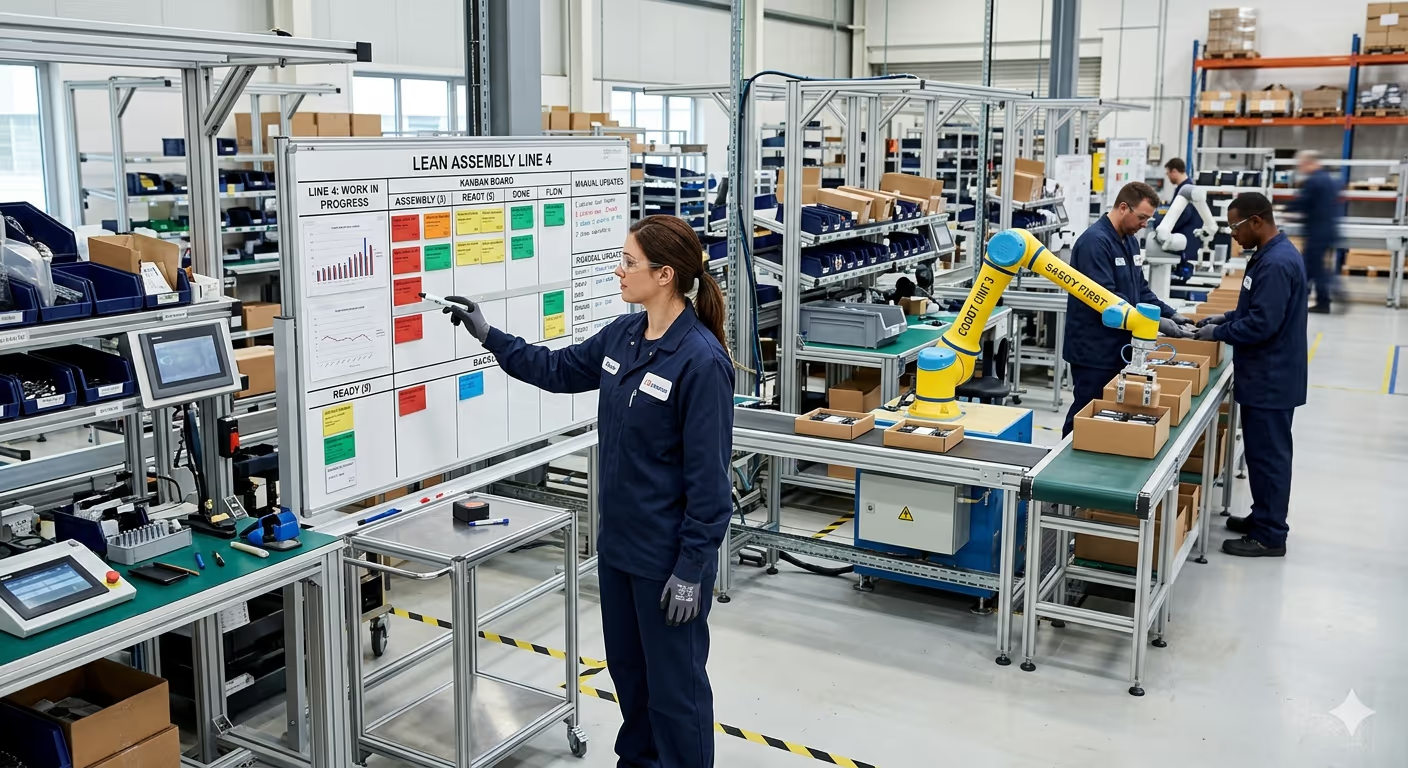
Lean Manufacturing and Industrial Automation
Lean Manufacturing and industrial automation reinforce each other when you standardize before automating. Avoid automating waste: practical guide and KPIs.
8 Jul 2026
EU funding for industrial automation 2026
EU and Spanish funding for industrial automation in 2026: ACTIVA, CDTI, ENISA, tax credits for robotics and how to apply step by step.