Lean Manufacturing and Industrial Automation
· by Panayot Dimkov
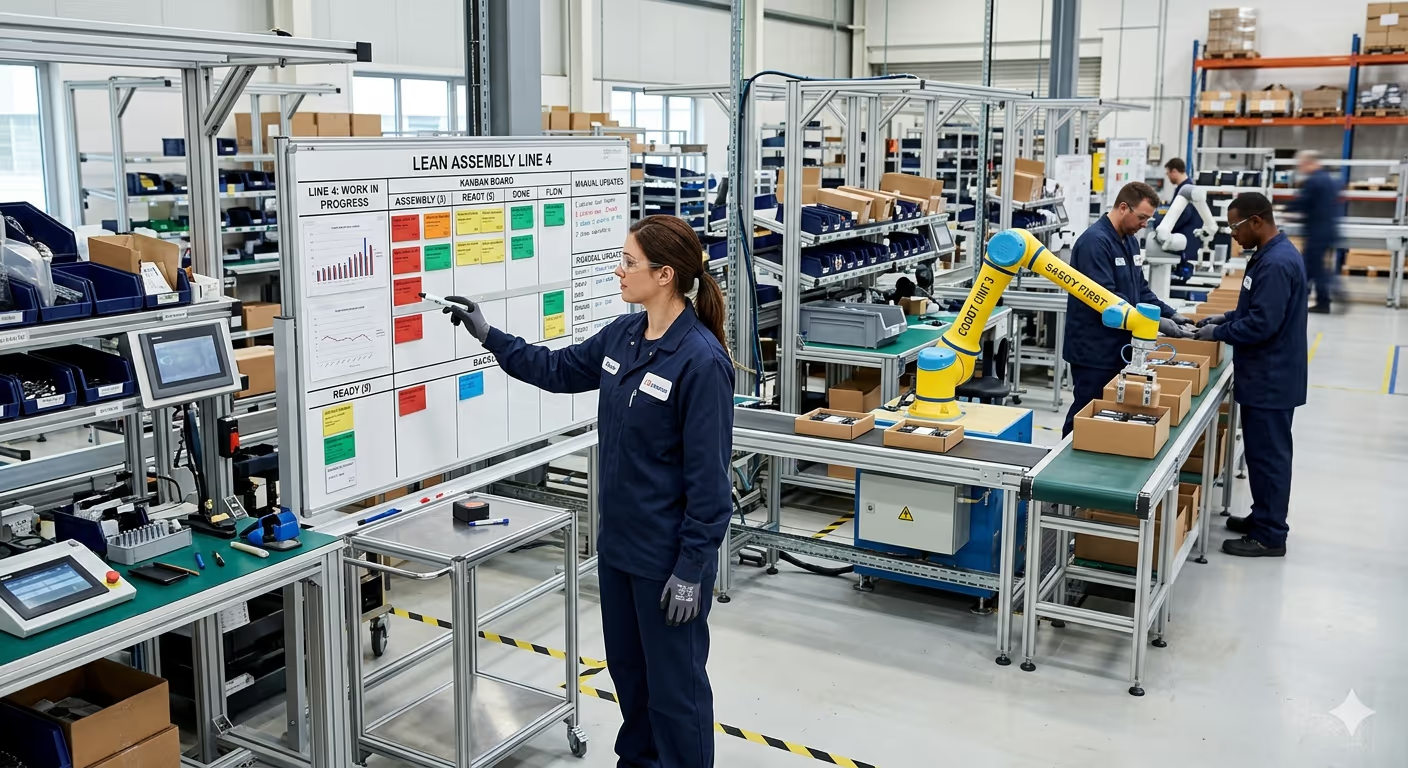
Lean Manufacturing and industrial automation are often pitched as opposites: one obsessed with simplifying and removing the superfluous, the other with filling the plant with robots and sensors. The opposite is true. Combined well, they reinforce each other; combined badly, automation amplifies the very problems Lean set out to solve. The difference lies in the order you do things.
1What Lean is and why automation needs it
Lean Manufacturing is the methodology born from the Toyota Production System whose goal is to maximize customer value by eliminating everything that does not add to it. That "everything that's left over" has a Japanese name — muda, waste — traditionally classified into seven types, plus one added later.
On this foundation, Lean deploys a toolkit any operations manager will recognize: Value Stream Mapping (VSM) to see the whole flow, kaizen continuous improvement, jidoka (automation with a human touch), poka-yoke mistake-proofing, SMED for fast changeovers, kanban to pull from demand, 5S for order and one-piece continuous flow. Automation replaces none of these ideas: it is the lever that executes them at a scale and reliability impossible by hand.
2The "automating waste" mistake
Picture a station where the operator walks four metres to fetch a part, inspects it by eye and drops it on an intermediate cart that piles up until the next station is free. If you automate that as-is — a robot walking the same four metres, a camera repeating the manual inspection, an automated buffer for the same WIP — you will have spent tens of thousands of euros making the waste faster. That is automating waste.
The problem gets worse because automation locks in the process. A bad method run by a person can be fixed in a five-minute meeting; the same bad method programmed in a PLC, wired in a cabinet and mounted in a robotic cell needs engineering, downtime and budget to change. Rigidity is the hidden cost of automating before thinking.
| Approach | What happens | Result |
|---|---|---|
| Automate without Lean | You speed up a process with built-in waste | Expensive, rigid bottleneck |
| Lean without automation | Efficient process but capped by human pace and fatigue | Real improvement with a ceiling |
| Lean + automation | You automate an already stabilized, simplified process | Scalable, sustainable efficiency |
3Standardize before automating: the right sequence
Standard work — the best known way to perform a task, documented and followed by everyone — is the foundation of Lean and, not by chance, the prerequisite for any reliable automation. A robot needs parts to arrive in a known position, the cycle to be repeatable and the variables under control. If your process still depends on each operator's "trick", it is not ready to be automated.
This sequence avoids the most frustrating scenario: an automated cell that works in the integrator's demo but jams every twenty minutes in production because material feeding was never standardized. To go deeper into the upstream flow design, we wrote a full guide on how to design an efficient production line that maps exactly onto steps 01 to 03.
4How automation supercharges each Lean tool
When the process is already stable, automation stops being a risk and becomes a multiplier. These are the combinations that work best on the shop floor:
The pattern is always the same: the Lean tool sets the goal (zero defects, zero waits, zero transport) and automation takes it to a level of reliability that manual work cannot sustain.
5The KPIs that prove it works
A Lean automation initiative is not justified by how modern it looks, but by how it moves the numbers. If you automate and these figures do not improve, you are not eliminating waste — you are just dressing it up as technology.
| KPI | What it measures | Success signal |
|---|---|---|
| OEE | Availability × Performance × Quality | Trending toward > 85% (world class) |
| Takt vs. actual cycle | Demand pace versus how long the station takes | Cycle ≤ takt, no overproduction |
| Lead time | Raw material to finished product time | Sustained year-on-year reduction |
| WIP | Work in process between stations | As low and stable as possible |
| Defect rate | % of non-conforming units | Drop after installing jidoka/poka-yoke |
The OEE is the headline indicator because it integrates the three losses Lean automation attacks: stoppages (availability), micro-stops and reduced speed (performance) and defects (quality). The Lean Enterprise Institute insists that measuring the value stream is the only way to know whether an improvement is real or merely apparent.
6Where to start (without overspending)
The good news for an industrial SME is that you don't need a million-euro investment to start. Lean is, at its root, a low-cost methodology: a whiteboard, a stopwatch and observation. Automation comes later, aimed precisely at the point the VSM flagged.
- Run a VSM on your most representative line and quantify waste in euros and minutes.
- Stabilize and standardize the bottleneck before touching anything electronic.
- Automate that point only, with the minimum viable technology: a cobot, a vision station, a poka-yoke sensor.
- Measure OEE, lead time and defects before and after. If they improve, reinvest in the next bottleneck.
- Repeat. Lean is a cycle, not a project with an end date.
This incremental approach is also the best way to grow competitiveness without growing headcount: each well-aimed automation frees up people's hours for higher-value tasks rather than simply replacing them. And for an investment benchmark, in how much it costs to automate a production line we break down real line items and timelines.
Frequently asked questions
Are Lean Manufacturing and automation compatible?
Yes, they are complementary. Lean defines what to optimize and automation is the tool to do it. The mistake is automating without applying Lean first, because that accelerates waste instead of eliminating it.
What does automating waste mean?
It means automating an inefficient process without redesigning it: you invest capital to do something that adds no value faster and more expensively (transport, waiting, overproduction). The result is an automated bottleneck that is hard to change.
Why should you standardize before automating?
Because automation locks the process into hardware and software. If the method is not stabilized and documented, you automate the worst version of your process. Standard work is the foundation for any improvement and any reliable automated cell.
Which Lean tools benefit most from automation?
Jidoka (automatic stop on anomalies) with machine vision, poka-yoke with sensors, SMED with assisted changeover, electronic kanban and digital 5S visual management. Automation amplifies each tool once the process is already stable.
Which KPIs show whether Lean automation works?
The main ones are OEE (availability × performance × quality), lead time, takt time versus actual cycle time, WIP and the defect rate. If automation does not move these indicators in the right direction, it is not eliminating waste.
Where should an industrial SME start?
With a Value Stream Mapping to see the real flow, stabilizing and standardizing the bottleneck, and only then automating that point with the minimum technology needed (a cobot, a vision station). Better to automate a little well than the whole line at once.
The bottom line
Lean Manufacturing and industrial automation do not compete: they need each other. Lean provides the judgment to know what is worth automating and automation provides the reliability to sustain the improvement. The trap is the order — automating before standardizing is automating waste — and the fix is always the same: map, stabilize, standardize, then automate the highest-impact point. At Nexum Automatics we support that full journey, from the Lean diagnosis to the rollout of the automated line and team training.
Is your process ready to be automated?
Before investing in technology, we help you map the flow, spot the waste and decide which point to automate first. Tell us about your case.
Talk to an expertNexum Blog
Related articles

5 Oct 2026
Power Automate Pricing and Premium Connectors
Power Automate pricing explained: what Premium, Process and Hosted Process cost, when premium connectors kick in and how to keep the bill under control.
6 Aug 2026
Robot cell safety standards: CE marking guide 2026
Which standards a robot cell must meet: EN ISO 10218, ISO/TS 15066, EN 60204-1, CE marking and who is responsible. A practical integrator's guide.
17 Jun 2026
SCADA vs HMI: differences and which to choose
Difference between SCADA and HMI: scope, historians, alarms, remote access and when you need each one. A clear guide from an industrial integrator.