How Much Does a Production Line Retrofit Cost?
· by Panayot Dimkov
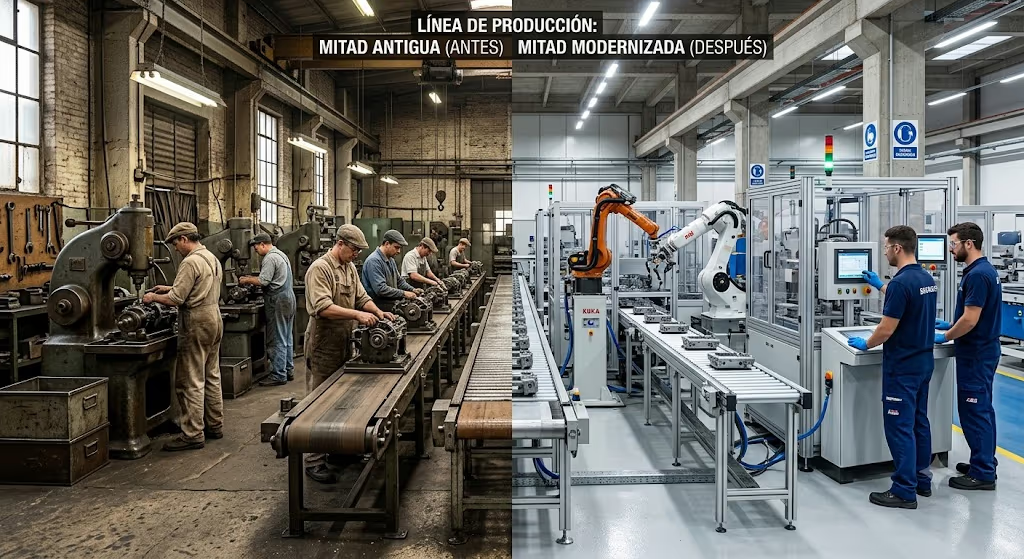
A production line retrofit costs, in orientative figures, between €20,000 and €60,000 if only the control system is modernised (PLC/HMI), between €50,000 and €150,000 if the drives are renewed as well, and between €150,000 and €400,000 for a complete line modernization. These ranges come from Nexum Automatics' project experience, and in this guide we break them down: what each level includes, when a retrofit beats a new line, how long it takes to pay for itself and how it is executed without stopping production for weeks.
This article assumes you already have a running line and that the problem is its age: discontinued controls, impossible spare parts, growing breakdowns or zero production data. If what you are considering is automating a manual line from scratch, your read is how much it costs to automate a production line.
1 How much does a production line retrofit cost?
The price of a retrofit is set by its scope: which layers of the line are renewed and which are kept. Based on Nexum Automatics' project experience, these are the orientative ranges for a typical industrial line (4–10 chained machines):
| Retrofit scope | What it includes | Orientative investment |
|---|---|---|
| Control only (PLC/HMI/SCADA) | Replacement of obsolete PLCs, new screens, reprogramming and data capture | €20,000–60,000 |
| Control + drives | The above + VFDs, starters, high-efficiency motors and associated wiring | €50,000–150,000 |
| Complete line | Electrical + control + mechanical work + safety upgrade | €150,000–400,000 |
Within each range, the items that move the figure most are engineering (line survey, program migration, testing), electrical and control hardware, and the installation hours worked in shutdown windows, which are paid at a compressed schedule: working three weekends costs more than three consecutive weeks, but it keeps the line producing.
2 What is a retrofit and when is it worth it vs a new line?
A retrofit is the selective modernization of an existing line: you keep what is still fit for purpose — usually the heavy mechanics, frames, conveyors, structure — and replace what has become obsolete: control, power electronics, sensors, safety. The economic reasoning is straightforward: the mechanics of a well-built line last 25–30 years; its control electronics are discontinued within 10–15.
The retrofit vs new line decision can be systematised with a practical rule:
There is a third factor that often decides: lead time. A new line can take 9–18 months across engineering, manufacturing and commissioning; a well-planned retrofit is executed in 3–6 months with the line producing almost the whole time. When the market won't wait, the retrofit wins even if the long-term maths is even.
3 The 4 levels of a retrofit
Not every retrofit touches every layer. Defining which levels are in scope is what turns a vague quote into a comparable one:
Level 4 deserves emphasis: when modernising a line, machine safety must be brought up to the current state of the art. That means assessing the safety-related control parts to ISO 13849-1 (required performance level, PLr) and the electrical equipment to EN 60204-1: emergency stops by category, door interlocks, isolation. A retrofit that renews the PLC and leaves the safety from 1998 in place is not a saving: it is a latent liability for the line's owner.
Level 2 is usually the heart of the project: discontinued PLCs (series the manufacturer no longer supports) are the number one cause of retrofits. The migration includes translating or rewriting the program, replacing I/O, renewing communications (from proprietary buses to Profinet/Ethernet-IP or OPC-UA) and, increasingly, connecting the line to a SCADA or MES so that it finally produces data as well as parts.
4 ROI: when the investment comes back
A well-scoped retrofit typically pays for itself in 12–24 months. The return comes from several sources that add up:
- Fewer unplanned stoppages: new electronics with available spare parts eliminate the "no spare exists" breakdowns that stop the line for whole days.
- Higher OEE: faster start-ups, fewer micro-stoppages and format changes assisted from the HMI.
- Energy savings: VFDs and high-efficiency motors cut consumption, especially on lines with many motors running continuously.
- Production data: with the line connected, predictive maintenance and continuous improvement stop being theory.
- Lower risk premium: safety at the state of the art and up-to-date documentation simplify audits and insurance.
Modernising existing lines also fits several industrial digitalisation grant schemes. Before budgeting, check which programmes are open: we explain it in European funding for industrial automation. A 20–40% grant on the investment turns a 24-month ROI into a 15-month one.
5 How long does production have to stop?
It is the question that decides many projects, and the honest answer is: much less than you fear, if the migration is planned in phases. The usual structure of a retrofit executed in windows is this:
| Phase | What happens | Line stopped? |
|---|---|---|
| 1. Audit and survey | Inventory of machines, signals, diagrams and programs; measurement of real condition | No |
| 2. Engineering and procurement | Electrical and control design, programming, manufacture of new panels | No |
| 3. FAT testing in the workshop | Panels and software tested against a simulator before setting foot in the plant | No |
| 4. Migration in stages | Machine-by-machine or section-by-section replacement in short windows | Windows of 24–72 h |
| 5. Commissioning and tuning | Assisted start-up, parameter tuning, operator training | Assisted production |
The phase 4 windows are placed where they hurt least: weekends, scheduled technical shutdowns or the August close. In many projects, the total effective downtime stays between 2 and 10 days, split into stages production can absorb. The price of this peace of mind is more careful engineering — temporary coexistence of old and new control, provisional wiring, a rollback plan in case a window goes wrong — and it is exactly where the integrator's craft shows.
6 Typical case: packaging line retrofit
An anonymised example, representative of the projects we deliver: a food packaging line with six chained machines, twenty years in service, discontinued PLCs, two different communication buses and growing breakdowns already costing several stoppages a month.
- Scope: full control retrofit (PLC, HMI and line SCADA), replacement of VFDs, safety upgrade to ISO 13849-1 and new electrical panels. Mechanics: only bearings and selected transmissions.
- Execution: four months of engineering and workshop with the line producing; migration in three weekend windows plus a final four-day stop for the central section.
- Investment: within the mid-to-high range of the table in section 1 (control + drives + safety), far below the cost of replacing the line.
- Result: obsolescence breakdowns disappeared, the line was connected to SCADA with OEE measured in real time, and management recovered the investment within two financial years thanks to the availability gained and the energy savings from the VFDs.
The pattern repeats across most retrofits: the money is not returned by the new technology itself, but by the line hours that stop being lost.
Frequently asked questions
How much does a production line retrofit cost?
Based on Nexum Automatics' project experience, a control-only retrofit (PLC/HMI) costs between €20,000 and €60,000; control plus drives (VFDs, motors) between €50,000 and €150,000; and a complete line modernization — electrical, control, mechanical and safety — between €150,000 and €400,000. These are orientative ranges: the final price depends on the number of machines, signals and the real condition of the line.
When is a retrofit worth it compared with a new line?
Practical rule: if the line's mechanics are healthy and the problem is control obsolescence, lack of spare parts or lack of data, a retrofit usually costs 30–60% of a new line and is worth it. If the mechanics are worn out, the process has changed radically or the retrofit cost exceeds 60–70% of a new line, replacement should be considered.
How long does a retrofit take to pay for itself?
Most well-scoped retrofits pay for themselves in 12–24 months, thanks to fewer unplanned stoppages, available spare parts, higher OEE and production data to improve the process. European grants and funds for industrial digitalisation can shorten the payback period even further.
How long does production have to stop during a retrofit?
With a phased, planned migration, most of the work (engineering, new cabinets, software and FAT testing) is done without touching the line. The actual cutover is concentrated in short windows — weekends, technical shutdowns or holidays — and in many projects the total effective downtime stays between 2 and 10 days, split into stages.
The bottom line
A production line retrofit costs between €20,000 and €400,000 depending on scope — control only, control plus drives, or the complete line — and usually comes in at 30–60% of a new line. The decision is made with the mechanics in hand: if they are healthy, the retrofit wins; if they are worn out, don't force it. Well planned, it is executed in short shutdown windows, pays for itself in 12–24 months and leaves the line with up-to-date safety, producing data as well as parts.
See how we do it in our automated production lines service.
How much would it cost to modernise your line?
Tell us what machines it has, what control it runs and what your shutdown window looks like. We audit the line, define the scope by levels and give you a realistic quote with its phased migration plan.
Request a quoteNexum Blog
Related articles
8 Aug 2026
SCADA for SMEs: when it pays off and what it costs
SCADA for SMEs: from how many signals it pays off, what an entry project costs (€15,000–40,000), phases, typical mistakes and available grants.
3 Jan 2026
Automated industrial plants: what are they, applications and when to implement them?
Could your production process be more efficient and safer? In this article we explain what automated industrial facilities are, where they are applied and when it makes sense to implement them.
30 Jun 2026
Lean Manufacturing and Industrial Automation
Lean Manufacturing and industrial automation reinforce each other when you standardize before automating. Avoid automating waste: practical guide and KPIs.