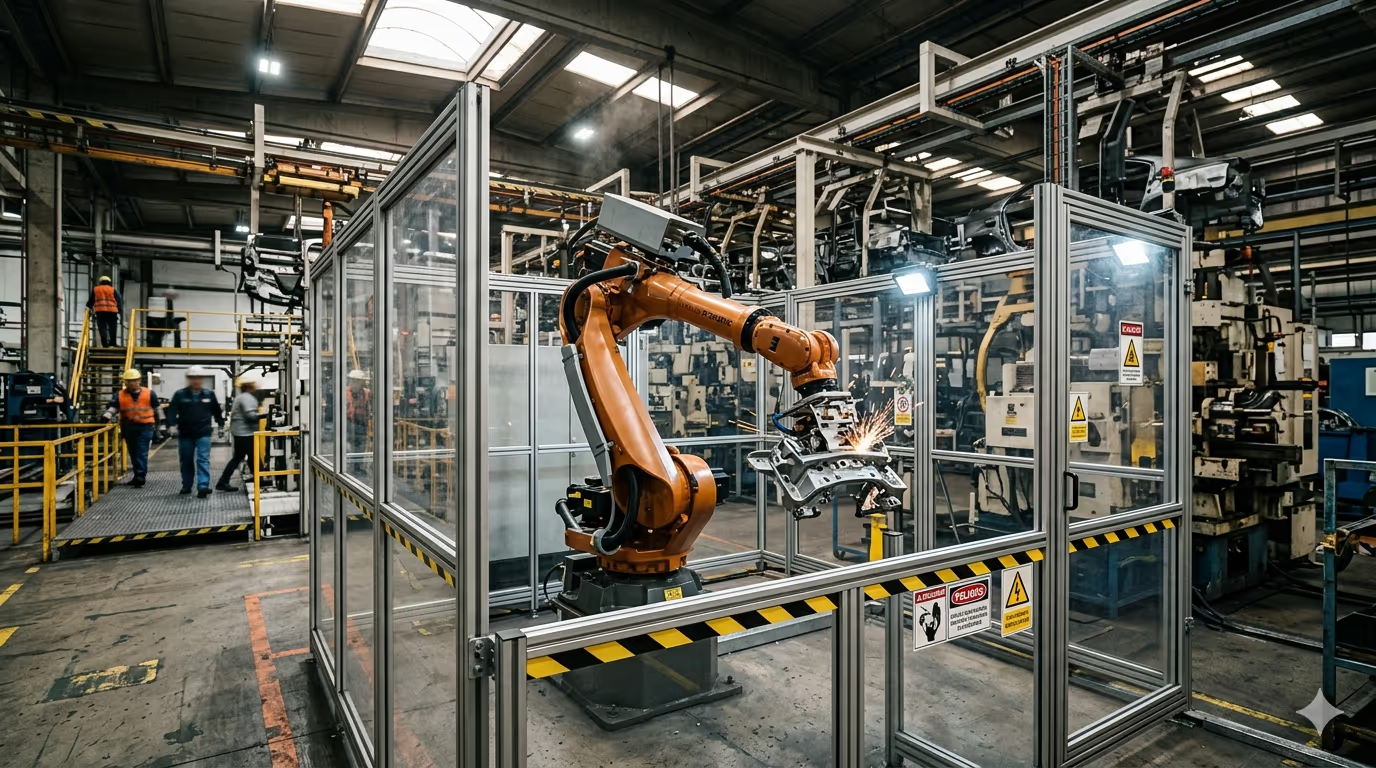
Robotic cell integration: cost breakdown
· by Panayot Dimkov
The cost of integrating a robotic cell is almost never the figure the robot manufacturer prints in its catalogue. The arm is only one part: what really drives the investment is the complete cell working at 100 % on your line —tooling, safety, electrical cabinet, engineering and commissioning included.
1 What a robotic cell includes (it's not just the robot)
When you ask for a quote to automate a task, you're not buying a robot: you're buying a robotic cell that has to pick, process and place real parts, safely and repeatably. These are the blocks that weigh on the price:
2 How much it costs: ranges by application type
The price of a robotic cell depends above all on what it has to do. These are indicative ranges for a complete, turnkey cell:
| Application | Complexity | Complete-cell range |
|---|---|---|
| Machine tending (load/unload) | Low-medium | €40,000–90,000 |
| End-of-line palletising | Medium | €50,000–120,000 |
| Pick & place / handling | Medium | €45,000–110,000 |
| Robotic welding | Medium-high | €70,000–180,000 |
| Machining, polishing or gluing | High | €90,000–250,000+ |
3 Where the money goes: cost breakdown
Spread over the total of a typical industrial cell, the spend distributes roughly like this. Seeing it explains why "a cheap robot" doesn't make the cell cheaper:
| Item | % of total | What it includes |
|---|---|---|
| Robot / cobot | 30–45 % | The arm and its controller |
| Tooling and fixturing | 15–25 % | EOAT, positioners, part feeding |
| Safety and fencing | 10–15 % | Guards, scanners, CE marking |
| Electrical cabinet and control | 10–15 % | Cabinet, PLC, drives, wiring |
| Engineering, assembly and commissioning | 15–25 % | Design, programming, simulation, install |
4 What makes the price vary
Two projects that "do the same thing" can be tens of thousands of euros apart. These are the factors that move the figure most:
- The part: weight, geometry, variety and fragility define tooling and robot.
- The cycle rate: demanding more parts per minute raises robot, fixturing and safety.
- Safety: coexisting with people or not completely changes the fencing.
- Part feeding: bulk, in trays or with machine vision raises the cost.
- Line integration: connecting to machines, MES or traceability adds engineering.
5 ROI: when a robotic cell pays for itself
Cost isn't measured only in euros, but in how long it takes to return them. In many palletising or machine-tending cells —where they replace repetitive three-shift tasks— the return on investment is usually under 2 years, and in light cobot applications it can drop below 12 months. Labour savings, higher availability, less scrap and consistent quality all weigh in.
That's why the useful question isn't "how much does the robot cost?", but "how much does the complete cell cost, and how fast do I get it back?". That's where an experienced robotic integrator avoids paying twice: sizing the cell to your real part and cycle rate, with no overspend or surprises. Reports from the International Federation of Robotics confirm this short-payback trend in industrial robotics.
Frequently asked questions
How much does a complete robotic cell cost?
A standard turnkey robotic cell usually costs between €50,000 and €250,000, depending on the application. The simplest cobot setups start around €25,000–50,000. The robot alone (€20,000–60,000) is only one part: the rest is tooling, safety, electrical cabinet and integration engineering.
Why does the cell cost so much more than the robot?
Because the robot is only 30–45 % of the total. The custom tooling, the safety fencing and CE marking, the electrical cabinet, the frame and, above all, the engineering and commissioning make up the rest. Buying a cheap arm doesn't make the complete cell cheaper.
Which robotic application is cheapest to integrate?
Machine tending and end-of-line palletising are usually the most contained (from €40,000–50,000), because the task is repetitive and the tooling is standard. Welding, machining or polishing cost more due to the fixturing and the precision required.
How long does a robotic cell take to pay for itself?
In many palletising or machine-tending cells the ROI is under 2 years, and in light cobot applications it can drop below 12 months. Labour savings, higher availability, less scrap and consistent quality all play a part.
What makes a robotic cell more expensive?
The part (weight, variety and fragility), the required cycle rate, the level of safety needed, how the parts are fed (in bulk or with machine vision) and integration with the rest of the line. The more demanding these factors, the bigger the investment.
In short
The cost of integrating a robotic cell is measured by the complete solution, not by the arm. Always ask for a turnkey cell quote, understand where the money goes and calculate ROI with your real figures. That way you invest once, and well.
See how we approach it in our robotic installations.
What would it cost to robotise your process?
Tell us your part, your cycle rate and your task. We size the complete cell and give you a realistic quote, with its ROI.
Request a quoteNexum Blog
Related articles
16 Aug 2026
How much does PLC programming cost? Real prices 2026
How much PLC programming costs: rates of €65-110/h and projects from €3,000 to over €25,000. Price factors and what a good quote must include.
1 Jul 2026
How much does a BMS cost? (2026 prices)
How much a BMS costs in an industrial unit: cost per point and per m², ranges by size, energy savings and the mistakes that blow the budget.
9 Jul 2026
Industry 4.0 Trends in 2026
The 8 Industry 4.0 trends of 2026 that truly move the needle: AI on the floor, machine vision, digital twins, cobots, edge computing and NIS2.