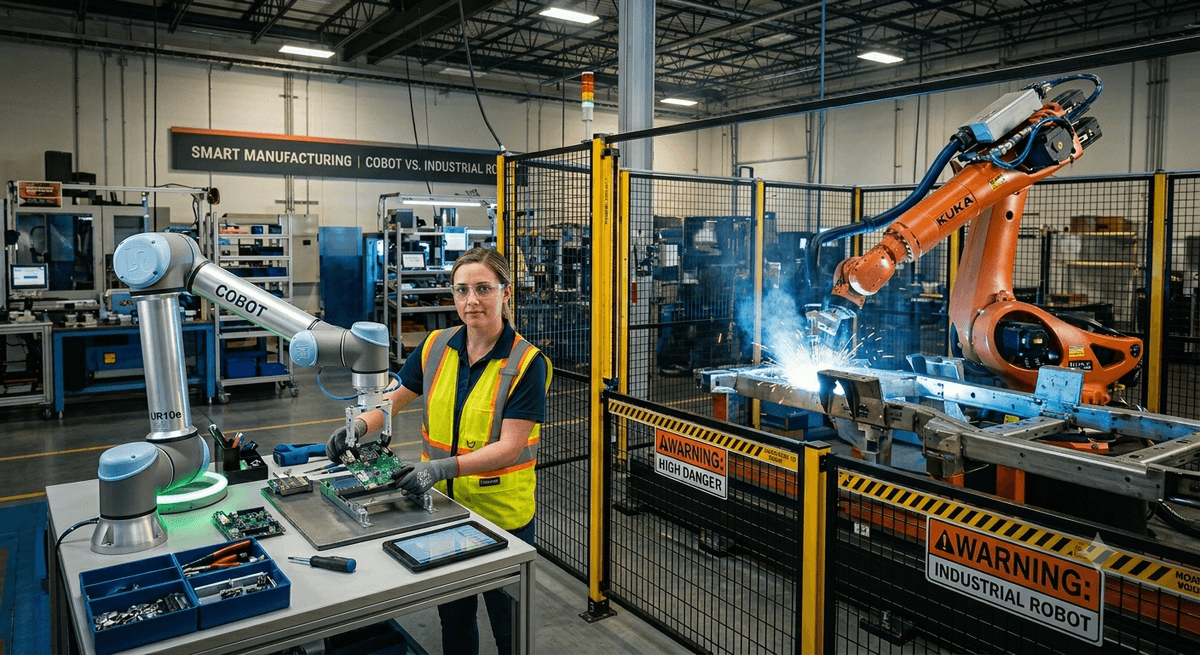
Cobot vs Industrial Robot: Which to Pick
· by Panayot Dimkov
Choosing between a cobot and an industrial robot is one of the first decisions in any automation project. And although at first glance they do the same thing —move, pick, weld or palletise—, the difference between a cobot and an industrial robot shapes safety, speed, investment and the kind of part you will be able to handle.
1 What a cobot is and what an industrial robot is
An industrial robot is a high-speed, high-precision articulated arm designed for mass production. It has been on automotive, metal and logistics floors for decades, repeating demanding paths at speed and with loads that can reach several hundred kilos. Because of its kinetic energy it must be isolated: a physical fence, light curtains or laser scanners that stop the robot if someone enters the work zone.
A cobot —short for collaborative robot— is an arm designed to work alongside people. It carries force and torque sensors in every joint that detect contact and stop the motion before it causes harm. That lets it, in many applications, do without the fence and be mounted within hours on a bench or a mobile cart.
The real distinction is not the brand or the shape of the arm, but the safe operating mode: the cobot is designed to limit its speed and force when a human is nearby, whereas the industrial robot gets its safety by physically separating the operator from the machine.
2 The 7 key differences between a cobot and an industrial robot
Beyond the «collaborative» label, these are the differences that really matter when deciding, summarised so you can compare at a glance:
| Criterion | Cobot (collaborative) | Industrial robot |
|---|---|---|
| Safety | Can run without a fence after a risk assessment | Fencing, barriers or scanners required |
| Speed | Limited (~250–1,000 mm/s in collaborative mode) | Up to 4× higher (2,000 mm/s or more) |
| Payload | Light to medium (3–30 kg) | Medium to very heavy (hundreds of kg) |
| Space and mobility | Compact and relocatable | Fixed installation, larger footprint |
| Programming | Hand guiding; running in hours | Expert programming; days or weeks |
| Investment | Lower (cell from €25,000–50,000) | Higher (cell €50,000–250,000+) |
| Ideal application | Short runs, high mix, next to operators | High volume, aggressive cycles, heavy loads |
3 Safety and standards: where the real boundary lies
This is where the most widespread misconception lives: «cobot» does not mean «safe by default». A cobot is safe only if the whole application is. A gripper with sharp edges, a pointed part or a badly tuned speed turn a cobot into a hazard, however collaborative the arm is.
The regulatory frame is set by the ISO 10218 family (safety of industrial robots, parts 1 and 2) together with the ISO/TS 15066 specification, which defines the admissible force and pressure limits for human-robot contact. The ISO 10218-2:2025 revision has folded that collaborative content directly into the standard, so cobot and industrial robot now share a single safety umbrella.
In practice, this means that both a cobot cell and an industrial robot cell need a risk assessment, CE marking of the cell and technical documentation. The difference is that for the cobot that assessment may conclude no fence is needed; for the industrial robot, it almost always is. You can read the detail in ISO/TS 15066 itself or in the reports of the International Federation of Robotics.
4 When to choose each one
It is not about which is «more modern», but about what your process demands. A quick way to orient yourself:
Choose a cobot if…
- You make short runs or a high product mix and need to reconfigure the cell often.
- The task shares space with operators and you don't want to occupy the floor with fencing.
- Loads are light: machine tending, screwdriving, inspection or light palletising.
- You want a contained investment and a fast commissioning.
Choose an industrial robot if…
- You produce high volume with fast, constant cycles.
- You handle heavy loads or large parts.
- The process is aggressive: intensive welding, casting, pressing or heavy palletising.
- Speed and cycle time are the critical factor of the line.
5 The answer is usually «it depends on the process»
In many plants the decision is not exclusive. It is common to combine a fast industrial robot at the heart of the line with cobots at the loading, inspection or end-of-line stations, where flexibility and coexistence with people matter more than raw speed.
That is why the choice should not be made by looking at a catalogue, but at the process: cycle times, product mix, loads, available space and the plant's expected evolution. This is where a robotics integrator brings the judgement that prevents buying the wrong robot and paying twice for the same station.
Frequently asked questions
What is the difference between a cobot and an industrial robot?
An industrial robot works at high speed and with heavy loads behind a safety fence, while a cobot (collaborative robot) operates more slowly and with lighter loads, but can share space with people without barriers after a risk assessment. The cobot prioritises flexibility and coexistence; the industrial robot, speed and power.
Is a cobot safer than an industrial robot?
Not by itself. A cobot is designed to limit its force and speed when it detects contact, but real safety depends on the whole application: tooling, part, speed and risk assessment. A well-fenced industrial robot cell can be as safe as a cobot; a cobot with a dangerous gripper is not.
How much can a cobot lift?
Cobots usually handle between 3 and 30 kg. Above that figure, or when cycle speed is critical, an industrial robot —which reaches loads of several hundred kilos— usually pays off.
How much does a cobot cost compared to an industrial robot?
A cobot arm is usually cheaper and faster to commission, but the real cost is that of the complete cell. A cobot cell starts at around €25,000–50,000 and a standard industrial robot cell ranges from €50,000 to €250,000 or more, depending on tooling, safety and engineering.
Does a cobot need a safety fence?
Not always. After a risk assessment in line with ISO/TS 15066, many cobot applications run without a fence. But if the tooling, the part or the speed raise the risk, it may be necessary to add guards, laser scanners or restrict certain zones.
Can a cobot replace an industrial robot?
For light, flexible tasks next to people, yes. For high-volume processes, heavy loads or very fast cycles, no: there the industrial robot is still more productive. In many plants the most cost-effective solution is for the two to coexist.
The bottom line
The difference between a cobot and an industrial robot is not about which is better, but about what your process needs: flexibility and coexistence with people, or speed and load. Before deciding, look at your cycle times, your loads and your product mix; and if in doubt, lean on someone who works with both.
See how we approach it in our robotic installations.
Cobot, industrial robot or both?
Tell us about your process, your parts and your cycle times. We analyse which one fits best —or how to combine them— and propose a tailor-made cell.
Talk to an expertNexum Blog
Related articles
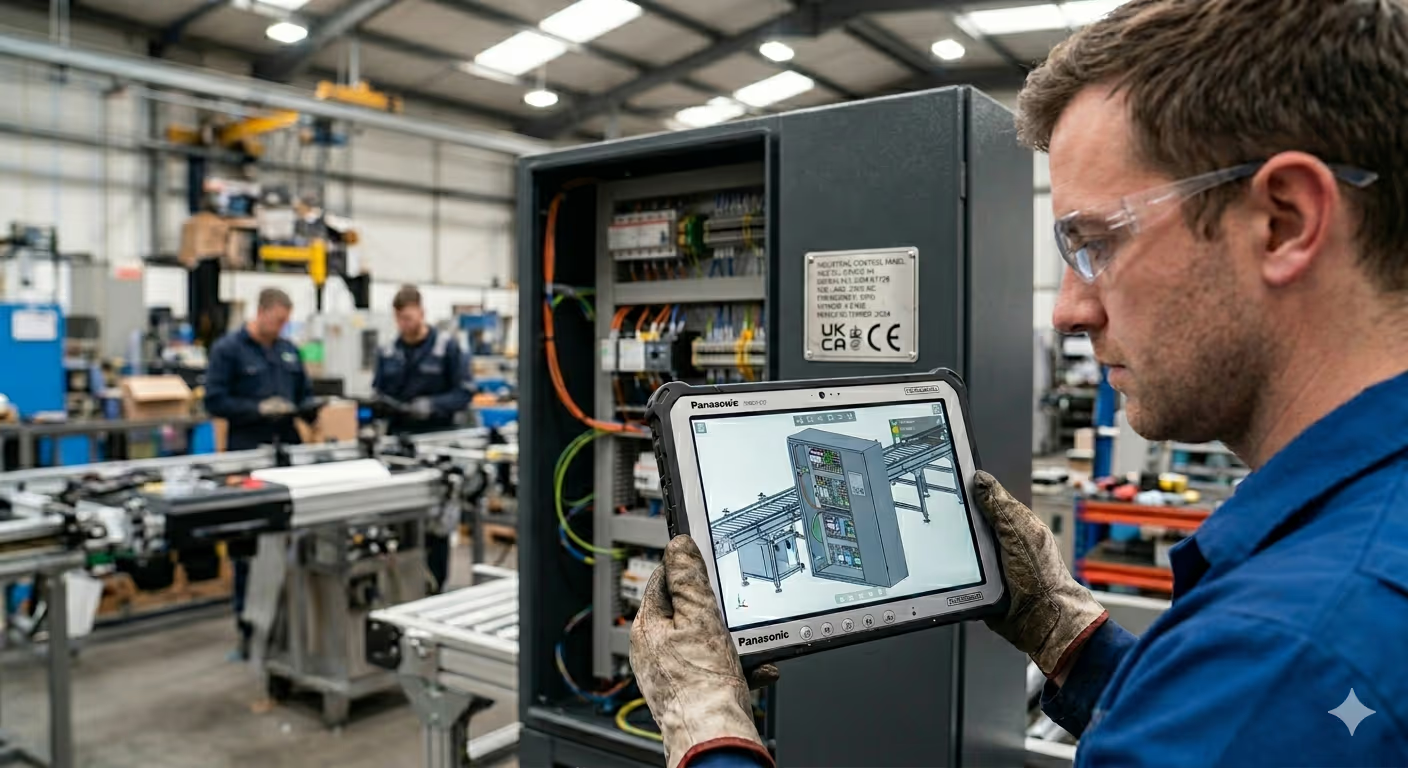
6 Jul 2026
Digital twin in industry: a 2026 guide
What a digital twin in industry is and isn't: types, real use cases, the technology you need and how to launch a pilot with measurable ROI.
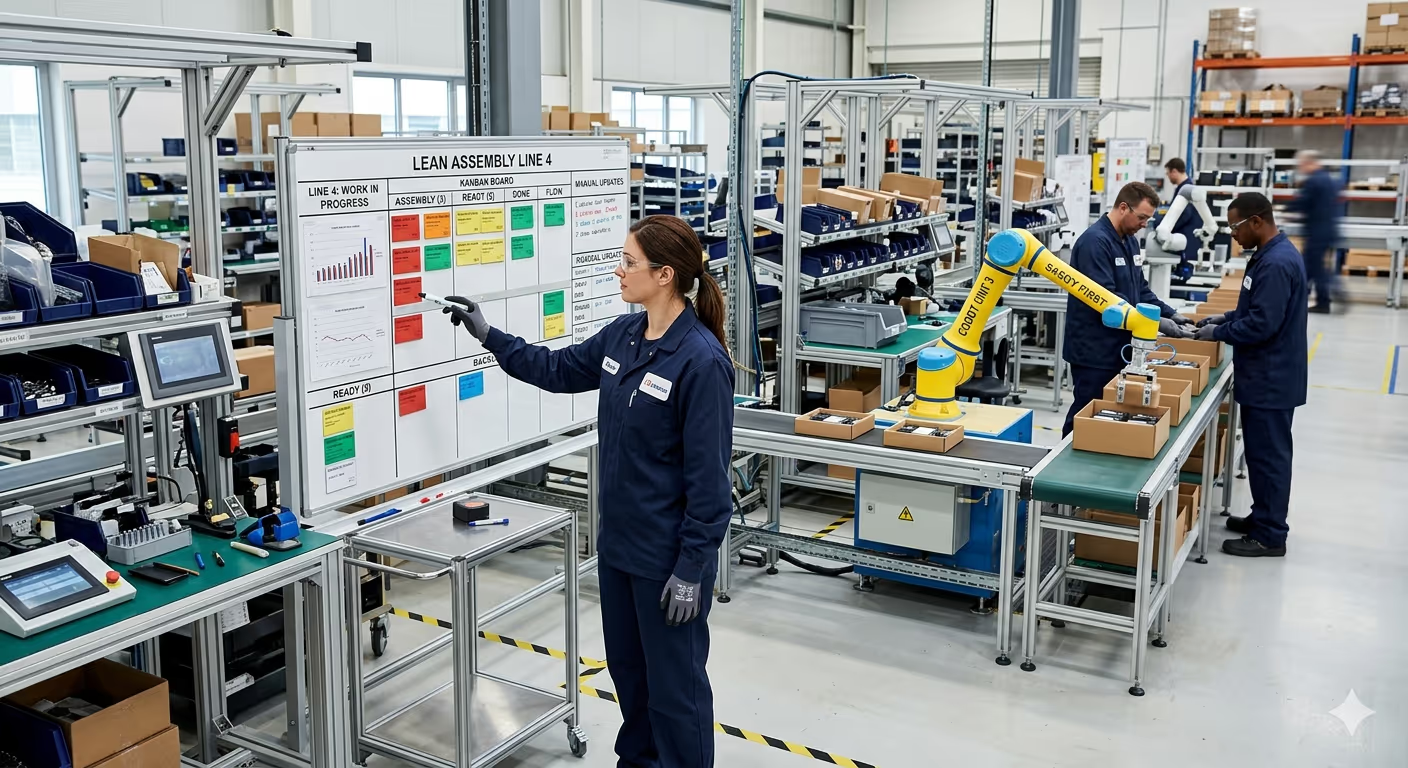
30 Jun 2026
Lean Manufacturing and Industrial Automation
Lean Manufacturing and industrial automation reinforce each other when you standardize before automating. Avoid automating waste: practical guide and KPIs.
1 Jul 2026
How much does a BMS cost? (2026 prices)
How much a BMS costs in an industrial unit: cost per point and per m², ranges by size, energy savings and the mistakes that blow the budget.