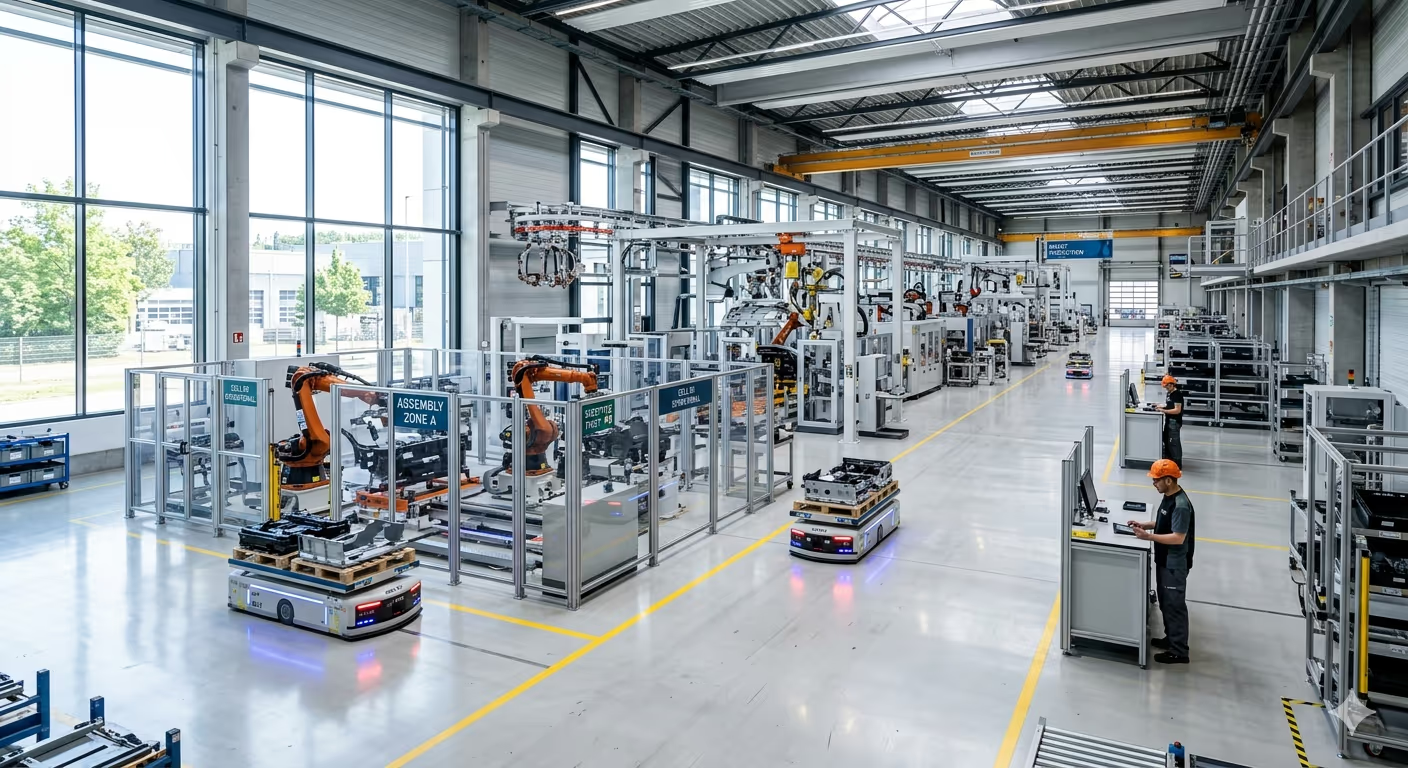
Industry 4.0 Trends in 2026
· by Panayot Dimkov
The Industry 4.0 trends of 2026 are no longer about buying the latest technology, but about integrating it with purpose: AI applied to manufacturing, digital twins, cobots, edge computing and OT cybersecurity that actually move the needle. This is the realistic, panoramic view of the eight trends that matter for industrial SMEs this year.
1AI applied to manufacturing and generative AI on the floor
Artificial intelligence is the trend that runs through all the others. In 2026 it stops being an isolated pilot and becomes part of daily operations: algorithms that correlate process variables, anticipate quality deviations and adjust line parameters in real time. The year's novelty is agentic AI, systems that not only analyse data but plan and act within defined boundaries, always with a human in the loop.
On the floor this lands in concrete things: assistants that answer in natural language "why did line 3 stop last night?", automatic work-instruction generation and guided fault diagnosis. How to start in an SME: don't buy an "AI platform". Pick a measurable problem (scrap, micro-stops, complaints) and apply AI to data you already have. If the data is dirty or scattered, that is the first project, not the second.
2Machine vision and AI-powered inspection
Machine vision is today the AI application with the clearest return in manufacturing. Cameras inspect 100 % of parts, with no fatigue or subjective judgement, and deep-learning models catch defects a rule-based system never saw: subtle scratches, texture variations, incomplete assemblies. What's relevant in 2026 is that training an inspection model no longer requires thousands of images or a dedicated vision team.
For an SME it is the ideal entry point to Industry 4.0: it solves a tangible pain (defects reaching the customer) with a bounded investment and a ROI measurable in fewer complaints and rework.
3Digital twins and virtual commissioning
The digital twin —a virtual replica of a machine, a cell or a whole line— moves from concept to engineering standard in 2026. Its most profitable use is virtual commissioning: validating control logic, cycles and interferences on the computer before spending a euro on steel. The digital-twin market for sustainable manufacturing already moves around USD 6.9 billion and grows at double digits per year.
An SME does not need to clone the whole factory. A bounded twin of the critical cell sharply reduces installation surprises, cuts ramp-up time and lets you test changes without stopping real production.
4Cobots and flexible robotics
Collaborative robots (cobots) are the fastest-growing robotics segment: a market of around USD 11.3 billion expanding near 28 % per year. Their 2026 advantage is not only safety alongside the operator, but flexibility: they are reprogrammed in hours, not weeks, and fit short runs and high product variety —exactly the scenario of most European industry.
The right question is not "cobot or industrial robot?" but "which task, at what cadence and payload?". Cobots shine at loading/unloading, screwdriving, light palletising and assisted quality control. For high cadence and heavy loads, the industrial robot with its safety fencing still wins.
5Edge computing and IIoT
Connecting machines (IIoT) is only half the job; the other half is deciding where the data is processed. The 2026 trend is edge computing: analysing data near the machine, in milliseconds, instead of sending everything to the cloud. This enables real-time control, cuts latency and traffic, and keeps the plant running even if the connection drops. The winning model is hybrid: the edge decides in real time, the cloud aggregates and trains.
For an SME, the edge is what makes the AI and machine vision above viable: without local processing there is no line-speed inspection and no reliable predictive maintenance.
6OT cybersecurity and the NIS2 directive
The more IT/OT connectivity, the larger the attack surface: nearly one in five industrial devices in some markets faced attack attempts in 2025. In 2026 OT cybersecurity stops being optional, pushed by the European NIS2 directive, which extends security obligations to many more industrial companies and their supply chain.
The approach that works is zero-trust: segment OT from IT networks, encrypt communications, control access and keep a live asset inventory. It is not a one-off project; it is a permanent layer over all the previous digitalisation.
7Sustainability, energy efficiency and green automation
Sustainability has consolidated as a cross-cutting axis, not an add-on. In 2026 three drivers converge: the cost of energy, ESG criteria and regulation. Automation delivers a double return here —productivity and energy savings— through real-time consumption monitoring, optimised start-ups and shutdowns, heat recovery and management systems that switch off whatever is not producing.
For industry, measuring consumption per machine and per product is the first step: you cannot optimise what you do not measure. Here supervision systems (SCADA) and building management become efficiency tools, not just control tools.
8Predictive maintenance and the labour shortage as a driver
Predictive maintenance —vibration, temperature and consumption sensors that anticipate failure before the machine stops— is where AI, IIoT and edge meet in a use case with direct ROI: fewer unplanned stops, fewer emergency spares, longer equipment life.
And here is the real driver behind the whole list: the shortage of qualified labour. With more than 60 % of industry unable to fill automation-engineer and industrial-developer vacancies, automation stops being an efficiency option and becomes the way to keep producing. You don't automate to lay people off; you automate because there is no one to hire.
| 2026 trend | What it is for | SME readiness |
|---|---|---|
| Applied / generative AI | Quality, diagnosis, decisions | Emerging |
| Machine vision | 100 % in-line inspection | Ready |
| Digital twin | Virtual commissioning | Emerging |
| Cobots / flexible robotics | Repetitive tasks, short runs | Ready |
| Edge computing / IIoT | Real-time data on the floor | Ready |
| OT cybersecurity (NIS2) | Protect the connected plant | Mandatory |
| Energy efficiency | Cut consumption and emissions | Ready |
| Predictive maintenance | Anticipate breakdowns | Ready |
How to land these trends in an industrial SME
The trap of any trends list is wanting to cover everything. The realistic path is the opposite: start from a measurable pain and let technology arrive as the solution, not the goal.
- Measure before you invest. Without OEE, scrap or consumption data, any investment is blind.
- Pick a case with clear ROI. Machine vision or predictive maintenance is usually the best first move.
- Design cybersecurity from the start. NIS2 won't wait; segment OT/IT from the first connected device.
- Scale by cells, not by the whole factory. A twin and a cobot in the critical cell before a total plan.
- Factor in the labour gap. Automate what you can't staff and upskill the people you have.
Frequently asked questions
What are the main Industry 4.0 trends in 2026?
The eight key trends of 2026 are: AI applied to manufacturing and generative AI, AI-powered machine vision, digital twins and virtual commissioning, cobots and flexible robotics, edge computing and IIoT, OT cybersecurity driven by NIS2, sustainability and energy efficiency, and predictive maintenance. The shortage of qualified labour acts as the cross-cutting driver behind all of them.
What is the difference between Industry 4.0 and Industry 5.0?
Industry 4.0 focuses on connecting and digitalising the factory (IoT, data, automation). Industry 5.0 adds a more human, sustainable and resilient approach: technology does not replace the operator but amplifies their capabilities. In 2026 both concepts coexist and the boundary is more a matter of nuance than a clean break.
Why is AI so important in manufacturing in 2026?
Because it stops being an isolated pilot and integrates into quality, maintenance and decision-making. The novelty is agentic AI, able to plan and act within defined boundaries under human supervision. The prerequisite is reliable data and an orderly process: AI amplifies a good process and also the chaos of a bad one.
Which Industry 4.0 trend should an SME adopt first?
The one that solves a measurable pain with clear ROI. In most plants that is machine vision for quality control or predictive maintenance, because the investment is bounded and the return is measured in fewer defects and stops. Before any investment, measure indicators such as OEE, scrap or energy consumption.
What does the NIS2 directive require from industrial companies?
NIS2 extends cybersecurity obligations to many more industrial companies and their supply chain: risk management, incident reporting, OT/IT network segmentation and management accountability. In practice it turns OT cybersecurity into a design and legal requirement from the first connected device.
Does automation replace workers in 2026?
In the European context, no: companies automate precisely because more than 60 % of industry cannot find qualified labour. Automation fills vacancies that are impossible to staff and frees people from repetitive tasks so they can focus on supervision, improvement and problem-solving.
The bottom line
The Industry 4.0 trends of 2026 are not eight independent projects but one idea: use AI, data and automation to produce better with fewer hands available, safely and sustainably. The difference between those who exploit them and those who suffer them is not budget, but starting from a measurable case and scaling cell by cell.
At Nexum Automatics we help industrial SMEs land these trends with judgement: from robotics and line automation to SCADA supervision.
Where should your Industry 4.0 start in 2026?
Tell us about your plant and your bottleneck. We propose the first project with clear ROI, no tech hype.
Talk to an expertNexum Blog
Related articles
4 Aug 2026
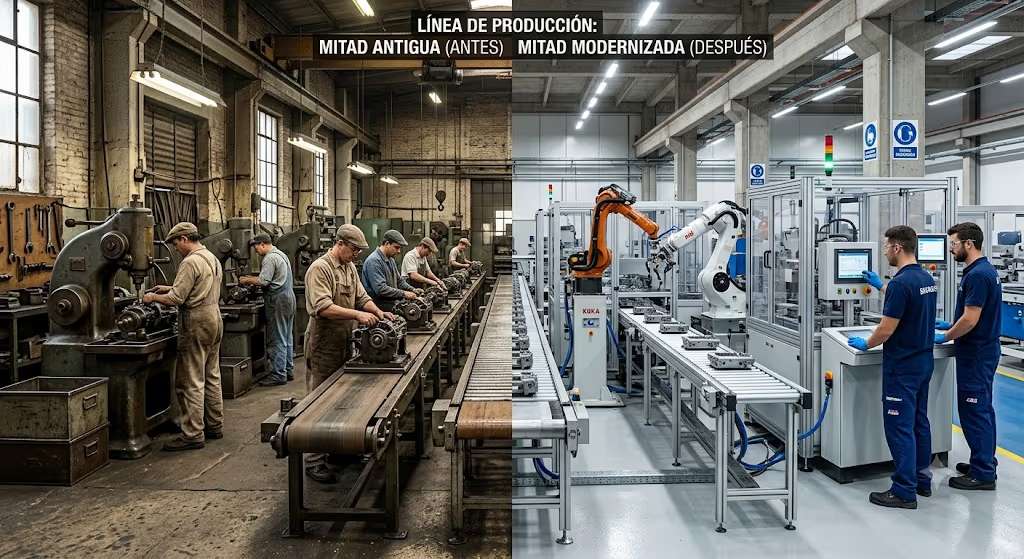
How Much Does a Production Line Retrofit Cost?
Production line retrofit cost: €20,000–400,000 depending on scope, the 4 retrofit levels, ROI in 12–24 months and how to avoid long production stops.
16 Aug 2026
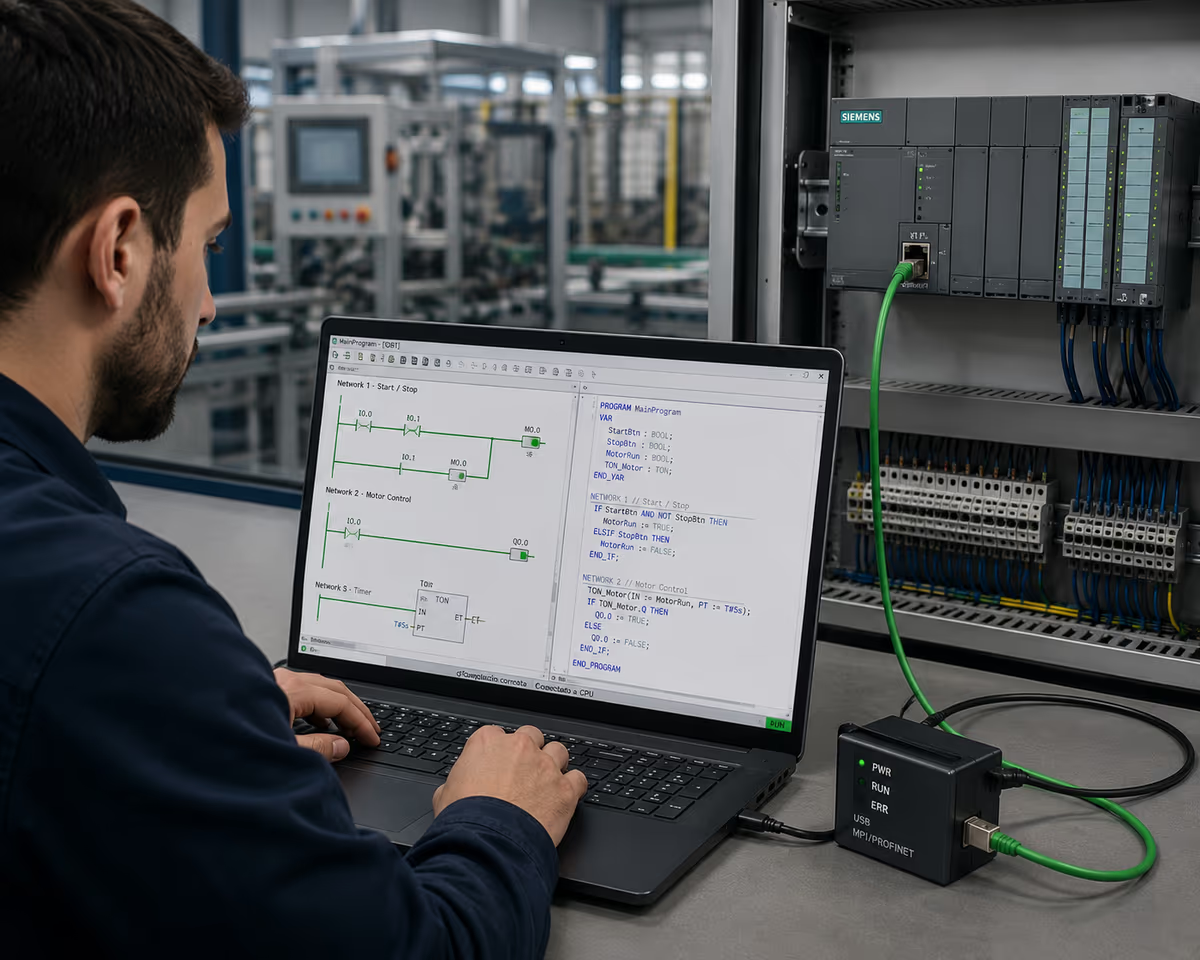
How much does PLC programming cost? Real prices 2026
How much PLC programming costs: rates of €65-110/h and projects from €3,000 to over €25,000. Price factors and what a good quote must include.

2 Oct 2026
Supplier Invoice Automation: The Real Cost
What it really costs to automate supplier invoices, the volume at which it pays off and how to run the numbers with your own figures before investing.