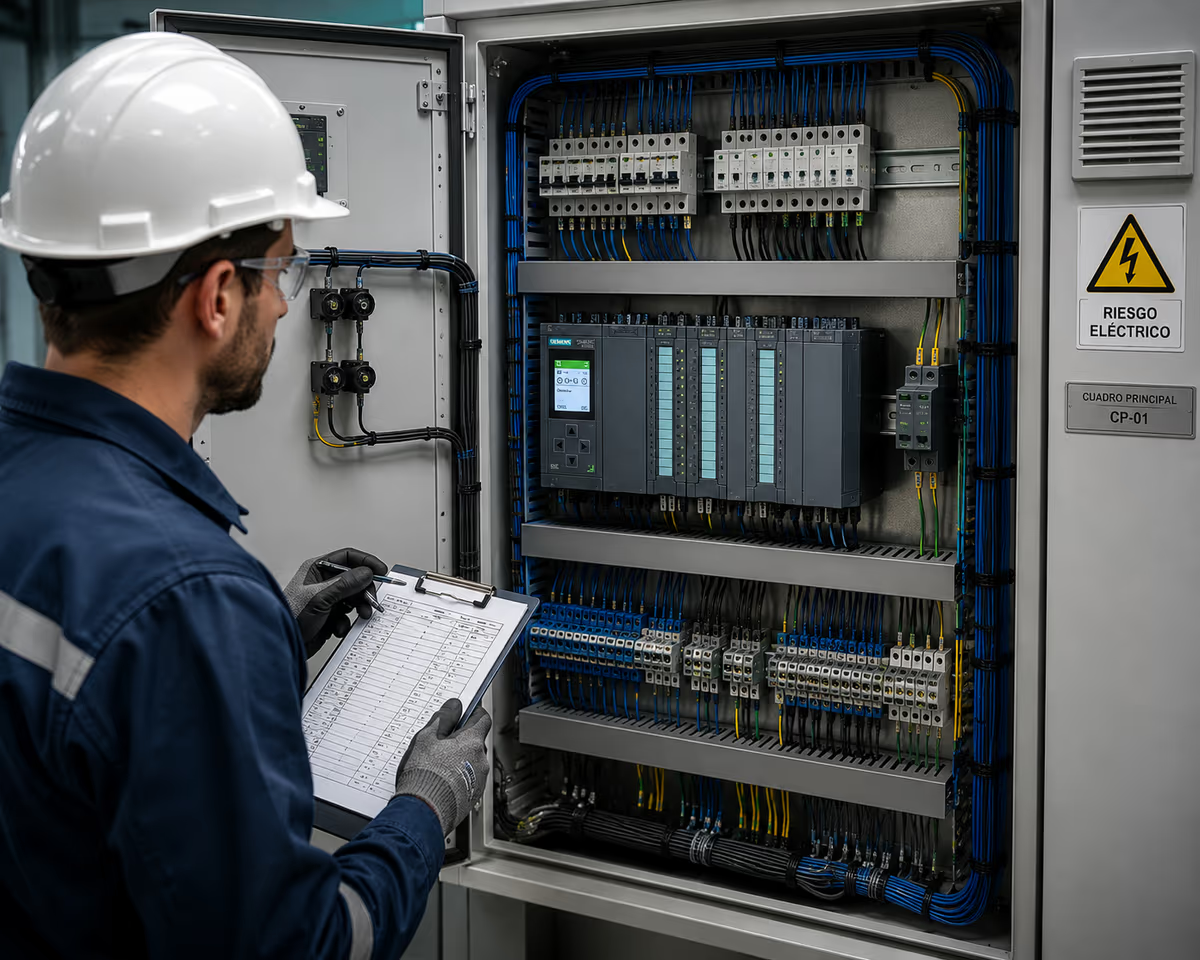
How to choose an industrial control panel manufacturer
· by Panayot Dimkov
Choosing an industrial control panel manufacturer is one of those decisions that looks like procurement but is really engineering: the panel is the electrical heart of the machine or the plant, and a mistake there is paid for over twenty years of operation. This guide sums up, from the side that builds and commissions, what to demand, what to ask before requesting a quote and which signals give away an offer that will end up expensive.
What should a good control panel manufacturer comply with?
Three non-negotiables: design verification to IEC 61439 with real, documented tests — not a mere declaration of conformity —, an in-house engineering office that calculates, sizes and signs the schematics, and documented FAT testing before delivery, with a protocol and results you can audit. Everything else — lead time, price, finish — is negotiable; this is not.
Why exactly these three? Because they cover the three moments where a panel can be born wrong. IEC 61439 verification guarantees that the assembly — enclosure, busbars, switchgear, ventilation — behaves as the paperwork claims under a short circuit or sustained heating; without tests behind it, it is a promise. The engineering office is the difference between a calculated panel (short-circuit currents, protection selectivity, thermal balance, space reserves) and a panel copied from the previous one. And the FAT (Factory Acceptance Test) is the filter that stops defects from travelling to site, where fixing them costs ten times more, with the installation at a standstill.
A vocabulary nuance worth mastering: the FAT takes place at the manufacturer's workshop, and the SAT (Site Acceptance Test) at your facility, with the panel already connected to the reality of the plant. A good manufacturer defines both in the offer, with a protocol and closed acceptance criteria; if the quote only says "final tests" with no further detail, ask what that means exactly and who signs off on what.
There is a fourth criterion, less visible but decisive in the long run: documentary traceability. As-built schematics delivered in editable format, a bill of materials with real brands and references, archived test protocols. The panel you buy today will be extended by another technician in eight years, and what he finds inside the cabinet door — or fails to find — will set the cost of that extension.
The 7 questions to ask before requesting a quote
Before comparing prices, level the playing field. These seven questions, sent in writing to every candidate, reveal more than any corporate brochure:
- 1. How do you verify the design to IEC 61439? Ask for the method (test, calculation or comparison with a tested design) and a sample report. Whoever truly verifies shows it without drama.
- 2. Do you have an in-house engineering office or do you subcontract the schematics? And which tool they work in (EPLAN, SEE Electrical…): it conditions the quality of the as-built you will receive.
- 3. What does your FAT protocol include? Dielectric strength, earth continuity, torque checks, functional tests of the logic… and whether you can attend in person or remotely.
- 4. Which switchgear brands do you quote, and are they substitutable? A panel with first-tier switchgear (or an agreed equivalent) can be maintained; one with unbranded, unreferenced gear cannot.
- 5. What documentation do you deliver with the panel? Editable as-built schematics, declaration of conformity, test reports, maintenance manual. Get the closed list into the contract.
- 6. Who answers after delivery, and how fast? Real warranty, response time on failure and availability of critical spares.
- 7. Can you show a project similar to mine? Same sector, same power rating or same type of control. A concrete reference is worth more than any framed certificate.
Which certifications actually matter?
The panel-building world is full of logos, but the standards that genuinely protect your investment are few and very specific. The reference is the framework of the IEC (International Electrotechnical Commission), from which the harmonised European standards derive:
| Standard | What it covers | When it applies |
|---|---|---|
| IEC 61439 | Design verification of the assembly: temperature rise, short circuit, insulation, IP/IK ratings | Always for low-voltage assemblies |
| EN 60204-1 | Electrical safety of machinery: emergency stop, colours, marking, testing | Always if the panel is part of a machine |
| ATEX (2014/34/EU) | Equipment for explosive atmospheres: enclosures, protection modes, Ex marking | Conditional in classified zones |
| UL 508A | Industrial control panels for the North American market | Conditional if you export to the US/Canada |
Two nuances that separate the informed buyer from the rest. First: the CE marking is not a certification; it is a self-declaration by the manufacturer, and its value depends on the test reports behind it — so ask for them. Second: IEC 61439 admits three verification routes (direct testing, calculation, and comparison with a tested design); all are legitimate, but the manufacturer must be able to tell you which one was applied to your panel and show you the result.
And don't forget the regulatory framework of the installation itself: in Spain, the panel will end up connected to an installation governed by the REBT (the national low-voltage regulation), and the installer will ask you for the assembly's documentation to legalise it. A manufacturer used to working with engineering firms and installers knows that circuit and hands over the paperwork without you having to chase it.
If your installation has explosion-risk areas — paint, flour, solvents, gas — the ATEX chapter deserves its own analysis: we develop it in our guide to ATEX electrical panels for hazardous areas.
Red flags in a cheap quote
An abnormally low quote is not a bargain: it is information. Something has been cut somewhere, and these are the cuts we have most often had to fix after the fact:
The fastest way to protect yourself: turn the seven questions of the previous section into purchase-order requirements. The cheap quote that cannot meet them stops being cheap in the comparison; the one that can is simply competitive — and those exist.
Pure panel builder or integrator with its own workshop?
One decision of model, not of price, remains: buying the panel from a pure panel builder (a workshop that only manufactures, from your schematics or a third party's) or from an automation integrator with its own panel workshop, which designs the control, builds the panel and commissions it.
The pure panel builder makes complete sense when the panel is a closed, repetitive product: runs of distribution boards, lighting panels, repetition of an already validated design. Its workshop is optimised for production, and at volume it will be hard to beat on unit price.
Things change when the panel is part of a machine or a process: it carries PLCs, drives, safety circuits, communications, and its schematic will evolve during commissioning. With a pure builder, every change crosses a boundary of responsibility: the programmer requests, the panel shop invoices the extra, and interface defects ("that wasn't in my schematic") get argued over with the line stopped. With an integrator that has its own workshop, that boundary does not exist: whoever designs the logic chooses the switchgear, the same team runs the FAT testing the real logic, and responsibility is one from schematic to commissioning. That is exactly the model we work with at Nexum Automatics from our workshop in Getafe (Madrid), described in detail in our industrial control panels service.
An honest guideline: if your project is "build me 40 identical panels from this validated schematic", look for a pure panel builder. If it is "I need the panel for this line, with its control, and it has to work", look for an integrator with a workshop. And if you are not even sure which type of panel you need, start with our overview of the types of industrial electrical panels.
And how much does it cost to build an electrical panel?
It depends on three variables that dominate everything else: power rating and switchgear, control content (PLC, drives, safety) and the associated engineering. From Nexum Automatics' project experience, a simple control panel sits at a few thousand euros, and a complete line-control panel with PLC and drives can multiply that figure several times; the item-by-item breakdown, with orientative ranges and the factors that raise the price most, is in our guide on how much it costs to build an industrial electrical panel.
What matters for this guide is something else: when you compare quotes, compare scopes, not figures. A panel with documented verification, FAT and as-built does not play in the same league as one with none of that, even if both carry the same name on the first line of the quote.
One last note on lead times, because they are cost too: switchgear with long delivery times — open-frame breakers, drives above a certain power — conditions the real delivery date more than the workshop's labour does. A serious manufacturer tells you so in the offer and reserves the critical material when the order is confirmed; the one promising "three weeks" without having checked stock is selling you a date, not a plan.
Frequently asked questions
What should a good control panel manufacturer comply with?
Three non-negotiables: design verified to IEC 61439 with real, documented tests (not a mere declaration), an in-house engineering office that calculates and signs the schematics, and documented FAT testing before delivery, with a protocol and results you can audit. Everything else — lead time, price, finish — is negotiable; this is not.
Which certifications should an industrial electrical panel have?
The baseline is IEC 61439 (design verification of the assembly) and, if the panel is part of a machine, EN 60204-1. If it is installed in explosive atmospheres it needs ATEX certification, and if it ships to the United States or Canada, construction to UL 508A. The CE marking summarises conformity, but always ask for the test reports behind it.
What is a FAT and why does it matter?
The FAT (Factory Acceptance Test) is the acceptance test at the manufacturer's workshop before shipping: torque checks, dielectric strength, earth continuity, protection devices and control logic, all against a signed protocol. It matters because fixing a defect in the workshop costs a fraction of fixing it on site with the installation at a standstill.
Is a pure panel builder better than an integrator with its own workshop?
It depends on the project. For repetitive runs of distribution boards, a pure panel builder is efficient. When the panel carries PLCs, drives and safety circuits — that is, when it is part of a machine or process — an integrator with its own workshop removes the boundary between builder and programmer: one single responsibility from schematic to commissioning.
The bottom line
A good panel manufacturer is recognised by what it can show you before charging you: the IEC 61439 verification with its tests, the calculations of its engineering office, its FAT protocol and a project similar to yours. Ask the seven questions in writing, demand the documentation in the order and distrust the quote that cannot answer them: the cheap panel is paid for in full at the first breakdown.
If you want to see how we do it, here is our industrial control panels service.
Need a panel that arrives tested and documented?
Send us your schematic or tell us about your process. We design, build in our Getafe workshop and deliver with a documented FAT and as-built schematics.
Request a quoteNexum Blog
Related articles

3 Jan 2026
Automated industrial plants: what are they, applications and when to implement them?
Could your production process be more efficient and safer? In this article we explain what automated industrial facilities are, where they are applied and when it makes sense to implement them.
17 Jun 2026
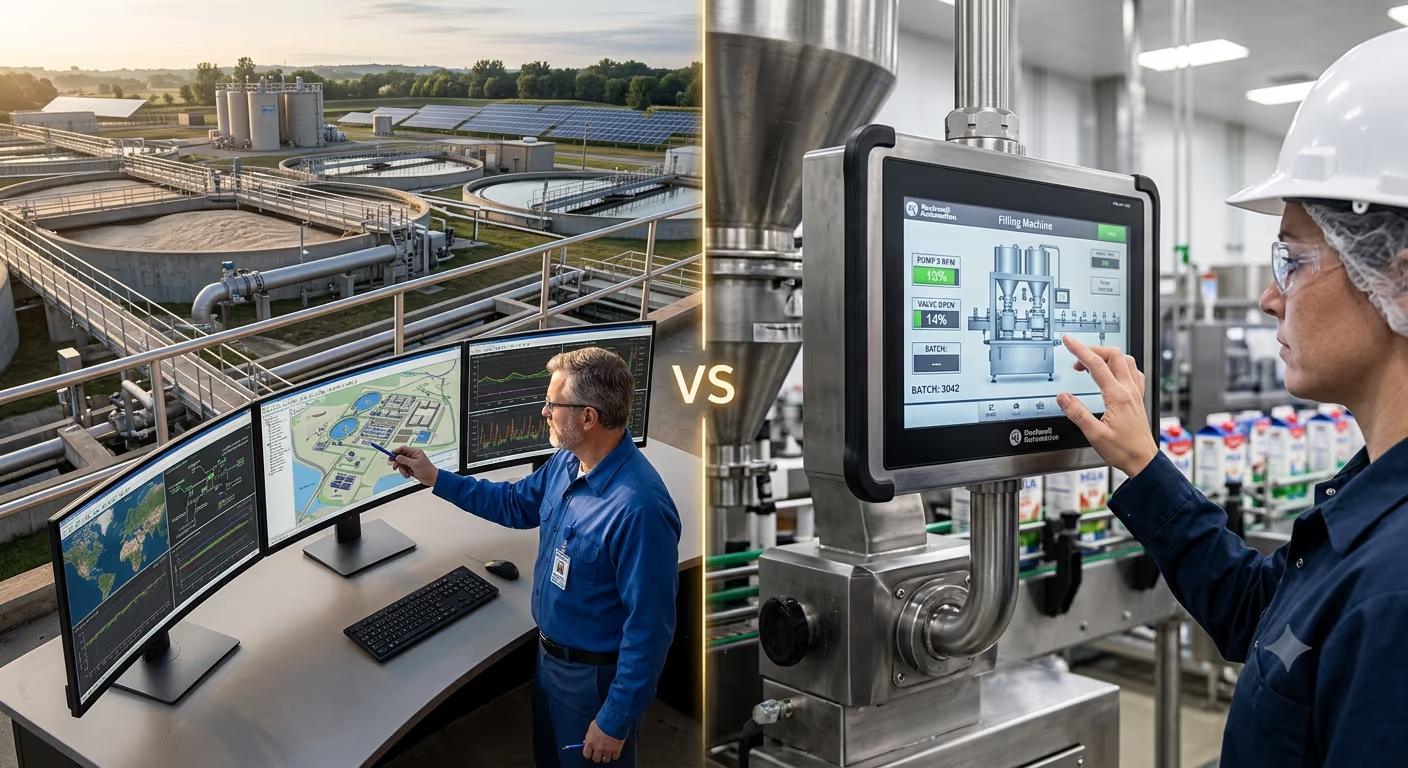
SCADA vs HMI: differences and which to choose
Difference between SCADA and HMI: scope, historians, alarms, remote access and when you need each one. A clear guide from an industrial integrator.
12 Aug 2026
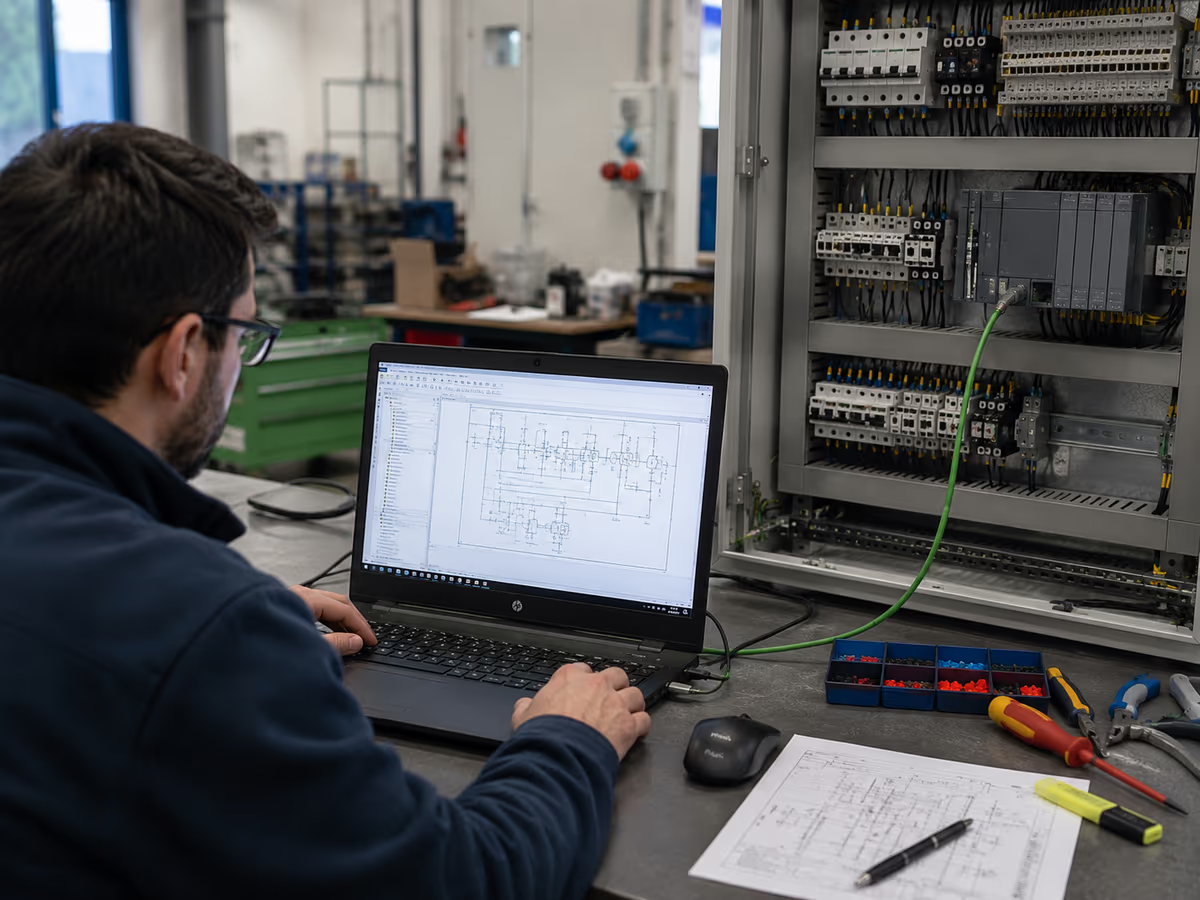
Industrial control panel design: phases and costly mistakes
Industrial electrical panel design in 5 phases: specification, EPLAN schematics, thermal sizing, IEC 61439 and documentation. An integrator's guide.