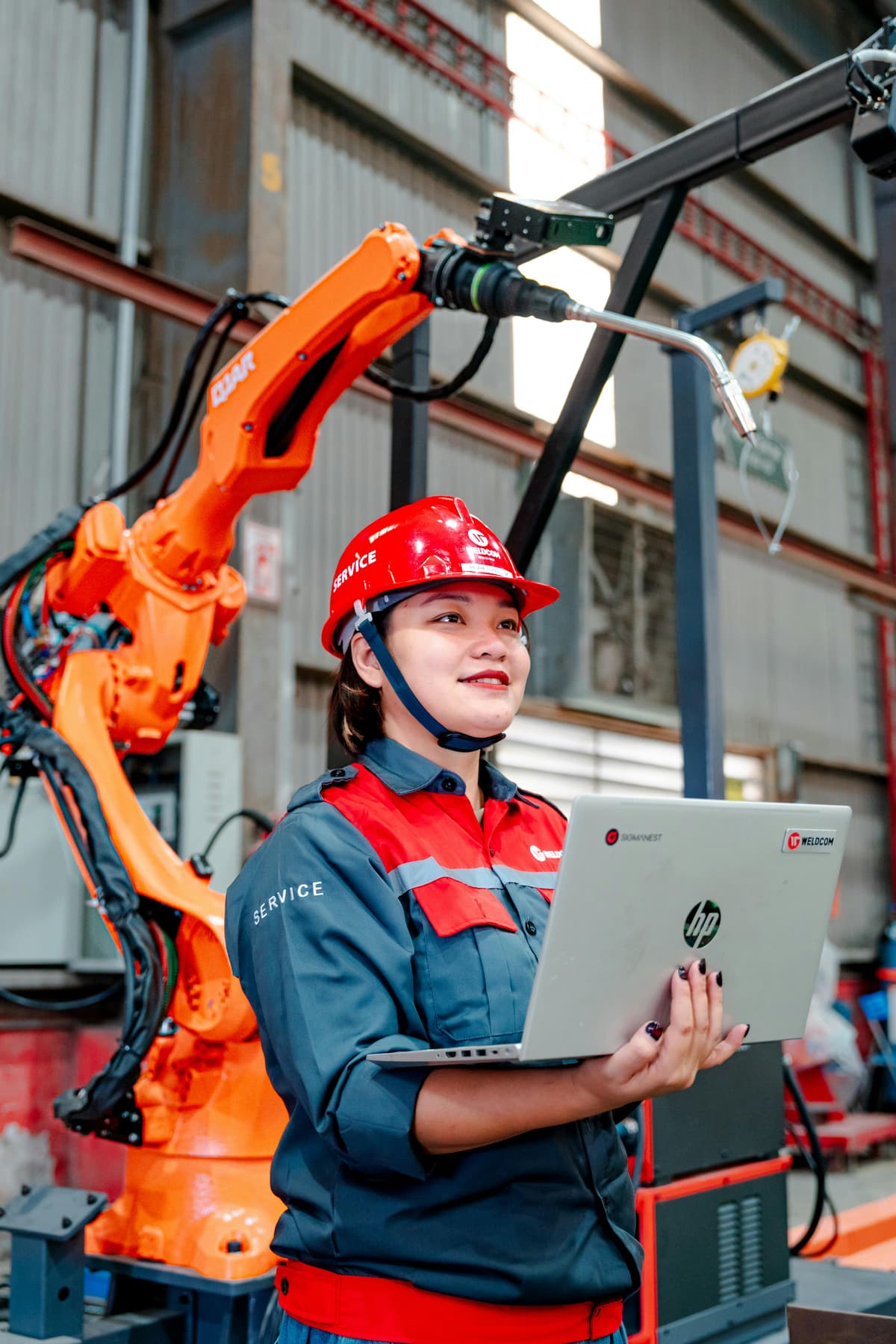
Industrial Robotics Integrator: What They Do and How to Choose One
· by Panayot Dimkov
An industrial robot integrator is the key component that transforms a robot—an isolated arm with no value on its own—into a production cell that solves a specific problem in your plant. This guide explains exactly what it does, what services it provides, and how to choose the right one.
1 What is an industrial robotics integrator
An industrial robotics integrator is an engineering firm that designs, manufactures, installs, and commissions custom robotic cells for specific production processes. It does not manufacture robots—it purchases them from FANUC, KUKA, ABB, Universal Robots, or others—and combines them with end-effectors (grippers, welders, vision cameras), electrical panels, safety systems, conveyors, and control software to create a complete solution that solves a specific customer problem.
The robot itself is just an articulated arm. Without an integrator, a company that buys a robot directly from KUKA or FANUC ends up with an expensive piece of equipment that does nothing until someone attaches a tool to it, programs it, connects it to a PLC, encloses it in a safety cell, and integrates it into the production flow. That "last mile" is what the integrator provides—and typically accounts for between 50% and 65% of the total project cost.
The price of the robotic arm is usually only 35–45% of the final cost of a cell. Tools, safety, the electrical cabinet, integration engineering, and commissioning account for the rest.
2 What services does a full-service integrator cover?
The scope of a serious robotic integrator goes far beyond “selling and installing a robot.” The typical phases of a project are:
- Process analysis and proposal: technical visit, flow study, robotic feasibility analysis, initial simulation, and layout proposal. Here, it is decided whether the project makes sense and which robot brand and model to use.
- Detailed engineering: mechanical design of the cell, selection of the robot and end-effector, 2D and 3D drawings, specification of safety components in accordance with EN ISO 10218 and EN ISO 13849.
- Electrical panel fabrication: design and fabrication in accordance with IEC 61439, including PLC, drives, and communications. The best integrators manufacture the panels in their own workshop rather than outsourcing them.
- Robot and PLC programming: trajectories, workpoints, recipes, communication with peripherals, HMI for the operator.
- Integration with existing SCADA or MES: via OPC-UA, Profinet, or EtherNet/IP for production visibility and traceability.
- FAT (Factory Acceptance Test): comprehensive validation of the cell at the integrator’s facilities prior to shipment. This is where 80% of issues are detected.
- Installation, technical support, and commissioning: on-site assembly, testing with actual product, fine-tuning, and final acceptance.
- Training for operators and maintenance technicians, plus complete technical documentation.
- After-sales support: preventive maintenance, modifications, upgrades, and troubleshooting.
3 Certified Integrator vs. Generic Integrator
Not all integrators are the same. The most important difference is official certification by the robot manufacturer:
| Manufacturer | Certification program | What it guarantees |
|---|---|---|
| FANUC | Authorized System Integrator (ASI) | Official training, priority support, extended warranty |
| KUKA | Authorized System Partner | Access to libraries, technical support, certified training |
| ABB | Authorized Value Provider | Full licenses, priority support, training |
| Universal Robots | Certified Systems Integrator | Access to the UR+ ecosystem, support, and training |
A certified integrator has passed the manufacturer’s technical certification processes: a minimum number of completed installations, official technician training, adequate workshop facilities, and documented quality processes. Certification guarantees priority access to technical support, spare parts, and updates, as well as the option to extend the robot’s official warranty.
A certified multi-brand integrator (KUKA + ABB + FANUC) can recommend the optimal brand for each application. A single-brand integrator tends to always push the same brand, even if it isn’t the best fit for your process.
4 How to Choose the Right Integrator
The technical and commercial criteria you should evaluate before signing a contract:
- Proven experience in your industry: ask for references you can visit, not just logos on a website. Each sector has its own requirements—automotive requires IATF 16949, pharmaceutical requires GMP and CFR 21 Part 11 traceability, and food processing requires AISI 316L and CIP compatibility.
- In-house electrical panel manufacturing capability: Integrators that manufacture their own electrical panels in accordance with IEC 61439 reduce interfaces with subcontractors, shorten lead times, and centralize technical responsibility. If the integrator outsources panels, you multiply the points of failure.
- Upfront process engineering: the best integrators perform Lean analyses (VSM, OEE) before proposing technology. Automating without first simplifying the process is automating waste.
- Multi-brand robot support: the ability to work with KUKA, ABB, FANUC, and Universal Robots allows for selecting the optimal brand for each application.
- In-house manufacturing capability: our own workshop with space for FAT prior to shipment. A thorough FAT in the workshop detects between 70% and 85% of problems before they appear on the production floor.
- Complete technical documentation: risk assessment (EN ISO 12100), EC declaration as the cell manufacturer (Machinery Directive 2006/42/EC), electrical schematics, annotated programs, manuals in Spanish.
- Contractually guaranteed after-sales support: maximum response time for remote support (4 hours) and on-site support (24 hours), with financial penalties for non-compliance.
5 Frequently Asked Questions
What exactly is an industrial robotic integrator?
An industrial robotic integrator is an engineering firm that designs, manufactures, installs, and commissions custom robotic cells. It purchases robots from FANUC, KUKA, ABB, or others, and combines them with end-of-arm tools, electrical panels, safety systems, and control software to solve a specific production process. The integrator assumes technical responsibility for the entire cell as the manufacturer in accordance with the Machinery Directive 2006/42/EC.
What is the difference between a robotic integrator and a robot manufacturer?
FANUC, KUKA, ABB, and Universal Robots manufacture robots—articulated arms with controllers and base software. An integrator does not manufacture robots: they purchase them and turn them into a production solution by combining them with end-of-arm tools, electrical cabinets, safety systems, communications, and process-specific programming. The investment in a robotic cell is roughly 40% for the robot and 60% for integration.
What services does a project with a robotic integrator include?
A complete project includes: process analysis and simulation, detailed engineering (mechanical and electrical), manufacturing of the IEC 61439 electrical cabinet, robot and PLC programming, integration with SCADA or MES, FAT at the integrator’s facility, on-site installation, technical support, and commissioning with actual product, operator and technician training, complete technical documentation including the CE declaration, and post-sales support. Without these phases, the cell is not legally usable in the EU.
What is a certified integrator and why does it matter?
A certified integrator has undergone official certification processes by the robot manufacturer (FANUC ASI, KUKA Authorized System Partner, ABB Authorized Value Provider, UR Certified System Integrator). Certification guarantees official technician training, priority access to support and spare parts, full software licenses, and the option to extend the robot’s official warranty. Working with an uncertified integrator may void the manufacturer’s warranty.
How much does it cost to hire an industrial robotics integrator in Spain?
The cost depends on the application: a complete cobot cell (palletizing or light assembly) starts at €25,000–€80,000. A cell with a standard industrial robot (welding, heavy palletizing, machine tending) costs between €50,000 and €250,000. Complex applications with machine vision and multi-robot systems can exceed €400,000. The robotic arm accounts for 35–45% of the total cost; the rest is integration, engineering, and installation.
Is a multi-brand integrator better, or one specialized in a single brand?
A multi-brand integrator (KUKA + ABB + FANUC) can recommend the optimal brand based on the application: FANUC for arc welding, KUKA for heavy loads and automotive, ABB for painting and food processing. A single-brand integrator tends to always push the same brand even if it isn’t the best fit for the process. The exception is when the customer already has an established internal standard for a specific brand and prefers to maintain consistency for maintenance and spare parts.
What warranty should a robotic integrator offer?
A minimum of 12 months on the complete system from the date of the SAT (Site Acceptance Test). It must cover failures of electrical and electronic components, programming errors detected during production, and premature wear of the end-of-arm tooling. Additionally, it requires a maximum response time guaranteed by contract: 4 hours remotely and 24 hours on-site, with explicit financial penalties in case of non-compliance. Without these contractual commitments, “commercial warranties” are worthless.
What documentation must the integrator provide upon completion?
Required documentation: EC Declaration of Conformity for the cell as a machine (Directive 2006/42/EC), risk assessment in accordance with EN ISO 12100 and EN ISO 10218-2, complete electrical schematics with safety component certificates, robot and PLC programs with backup copies, operation and maintenance manual in Spanish, signed FAT protocol, and SAT protocol following commissioning. This documentation is required for the legal use of the cell in the EU and for audits.
Are you looking for a certified robotics integrator in Spain? Nexum Automatics is an integrator with experience in KUKA, ABB, and FANUC, and manufactures its own electrical panels.
Contact Nexum →Nexum Blog
Related articles
12 Aug 2026
Industrial control panel design: phases and costly mistakes
Industrial electrical panel design in 5 phases: specification, EPLAN schematics, thermal sizing, IEC 61439 and documentation. An integrator's guide.
3 Jan 2026
Automated industrial plants: what are they, applications and when to implement them?
Could your production process be more efficient and safer? In this article we explain what automated industrial facilities are, where they are applied and when it makes sense to implement them.
16 Aug 2026
How much does PLC programming cost? Real prices 2026
How much PLC programming costs: rates of €65-110/h and projects from €3,000 to over €25,000. Price factors and what a good quote must include.