Modbus vs Profinet vs OPC UA: which one to use
· by Panayot Dimkov
If you are designing or modernising your factory's communication network, sooner or later you hit the same question: Modbus vs Profinet vs OPC UA — which one should you choose? The short answer is that they are not direct rivals: each one dominates a different layer of the plant, and the right architecture almost always combines two of them — or all three.
Modbus, Profinet or OPC UA: which one should your plant use?
Use Modbus TCP (or RTU) to integrate simple, slow or legacy devices: energy meters, power analysers, basic drives, old hardware that already works. Use Profinet wherever the process demands deterministic millisecond cycles: distributed I/O, synchronised drives, motion control and functional safety with PROFIsafe. Use OPC UA for everything that goes from the PLC upwards: SCADA, MES, historians, analytics and cloud — in other words, the boundary between OT and IT.
Choosing "one for everything" is the classic mistake. Modbus cannot deliver the determinism a fast line requires; Profinet is not meant to cross the corporate network; and OPC UA does not replace a fieldbus in the control cycle. The useful question is not "which is best" but which protocol belongs at each layer of your architecture. Let's go protocol by protocol and then put it all together.
1 Modbus: the veteran that refuses to retire
Modbus was born in 1979 at Modicon (now part of Schneider Electric) to connect its PLCs, and it has since become the most widespread industrial protocol in the world. Today it is an open, royalty-free standard managed by the Modbus Organization. It comes in two main flavours: Modbus RTU over RS-485 serial lines and Modbus TCP over standard Ethernet.
Its operation is deliberately simple: a client (master) asks and a server (slave) answers by reading or writing 16-bit registers. That simplicity is its great strength: it can be implemented in any device however cheap, it can be debugged with free tools, and every automation technician knows it.
Modbus strengths and limits
- Strengths: open and free, universal, trivial to implement and debug, perfect for integrating third-party equipment and old hardware.
- Limits: no data model (just flat registers with no units or semantics), no native security, no determinism (it works by polling), and no network diagnostics or device discovery.
Typical uses: energy meters and power analysers, variable-speed drives in non-critical duties, temperature and slow peripherals, integration of legacy machines and communication with third-party equipment that "at least speaks Modbus".
2 Profinet: deterministic real time in the field
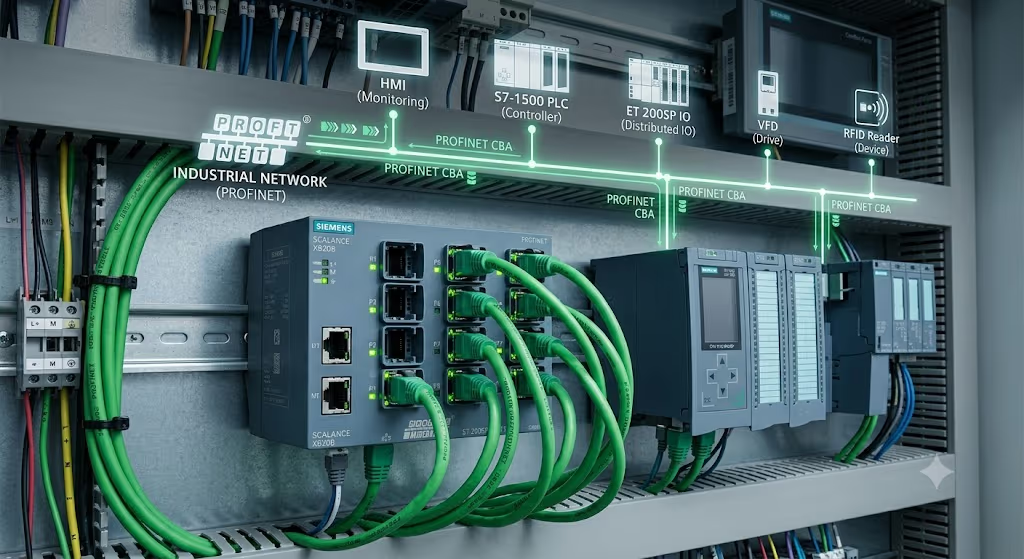
Profinet is the industrial Ethernet standard promoted by PROFIBUS & PROFINET International (PI), the natural heir of Profibus. Unlike Modbus TCP, which uses Ethernet "as is", Profinet prioritises process traffic to guarantee cycle times: the RT (Real-Time) class works in 1–10 ms cycles, and the IRT (Isochronous Real-Time) class goes below 1 ms with microsecond jitter — enough to synchronise axes.
Beyond performance, Profinet delivers what Modbus never had: per-device and per-channel diagnostics (you know which card and which channel failed), network topology visible from the engineering tool, media redundancy (MRP) and profiles such as PROFIsafe for functional safety and PROFIenergy for energy management.
Profinet strengths and limits
- Strengths: true determinism, fine-grained diagnostics, seamless integration with the Siemens/TIA Portal ecosystem, functional safety over the same cable.
- Limits: it needs certified hardware and managed switches to shine, engineering is more demanding than with Modbus, and although it is an open standard, its real-world ecosystem in Europe gravitates around Siemens.
Typical uses: line-level remote I/O, drives and servo drives, robotic cells, coordinated motion control, and any automated industrial process where a late message means bad product or a stoppage.
3 OPC UA: the universal translator between OT and IT
OPC UA (Open Platform Communications – Unified Architecture, standard IEC 62541) is maintained by the OPC Foundation and plays in a different league: it is not a fieldbus but an information-oriented service layer. Where Modbus transmits "register 40001 = 173", OPC UA transmits "Pump_3.Temperature = 17.3 °C, with unit, range, status and timestamp". Data travels with its semantics.
Its three hallmarks: a hierarchical, typed information model (extendable with sector-specific companion specs), built-in security as standard (X.509 certificates, signing and encryption, user authentication) and total platform independence: it runs equally on a PLC, a Linux server or the cloud, in client-server or publisher-subscriber mode.
OPC UA strengths and limits
- Strengths: real interoperability between vendors, native security, contextualised data ready for MES, historians and analytics, scalable from sensor to cloud.
- Limits: in its classic form it is not deterministic (the OPC UA FX extensions over TSN are still maturing), it consumes more resources than Modbus, and it requires a well-designed information model so you don't just move the register chaos into another format.
Typical uses: multi-vendor PLC–SCADA communication, MES/ERP integration, historians and digital twins, secure data delivery to the cloud and IT/OT gateways.
4 Head to head: Modbus vs Profinet vs OPC UA
This table sums up the five criteria that really matter when deciding, based on what we see in real integration projects:
| Criterion | Modbus TCP | Profinet | OPC UA |
|---|---|---|---|
| Speed | Milliseconds to seconds, by polling | 1–10 ms (RT), <1 ms (IRT) | Milliseconds to seconds, by subscription |
| Determinism | No | Yes, guaranteed | No (except OPC UA FX/TSN) |
| Security | None native | Segmentation + recent security classes | Encryption, certificates and authentication as standard |
| Implementation cost | Very low | Medium-high (certified hardware, managed switches) | Medium (server/SDK licences, modelling) |
| Ecosystem | Universal, every vendor supports it | Very strong in Europe, centred on Siemens | Cross-domain: automation, IT and cloud |
5 The typical architecture: each protocol at its layer
In a well-designed plant, the three protocols appear neatly ordered by level, following the logic of the automation pyramid:
The PLC acts as the hinge: downwards it speaks Profinet with the fast peripherals and Modbus with the simple devices; upwards it exposes its data as an OPC UA server towards the SCADA and the MES. This keeps the deterministic traffic confined to the cell network while business data travels with security and context. If you are unsure where the PLC ends and supervision begins, we clear it up in our comparison SCADA vs PLC.
A side benefit of this layered separation is cybersecurity: every boundary between levels is a natural point for segmentation and filtering — something the NIS2 directive now formally requires in many industries. We cover it in our guide to OT cybersecurity and NIS2.
6 Migrating from legacy without stopping the plant
Most factories don't start from scratch: they start from a mix of Modbus RTU, proprietary buses and the odd Ethernet island. The good news is that migrating does not mean replacing everything. The strategy we apply, from least to most intrusive:
- Start with supervision: deploy an OPC UA server (in the SCADA or a gateway) that reads the legacy over Modbus and publishes it with a clean data model. Zero downtime.
- Concentrate the serial lines: group RS-485 devices behind Modbus TCP gateways to eliminate fragile wiring and gain network diagnostics.
- Migrate the field cell by cell: when a machine or line is refurbished, move its peripherals to Profinet during the planned shutdown; use Modbus–Profinet gateways for whatever isn't due for renewal yet.
- Normalise names from day one: define the OPC UA information model (plant–line–machine–signal hierarchy) before connecting anything, or you will inherit the register chaos forever.
This phased approach spreads the investment, keeps production running and turns each migrated cell into the blueprint for the next one.
7 What we use at Nexum and why
At Nexum Automatics we are not zealots for any protocol: in our integration projects in Getafe and across Spain all three coexist, each in its place. At field level we mostly work with Profinet, because most of our process and line projects are built on Siemens PLCs and distributed peripherals, and per-channel diagnostics saves hours of maintenance. We use Modbus TCP as the glue with the real world: meters, power analysers, burners, chillers and every third-party machine that arrives with a "Modbus port" as standard.
And at the supervision layer, OPC UA is our default choice to connect PLCs with SCADA and IT: it gives us vendor independence, certificate-based security and a data model the customer actually understands. The result is an architecture where changing the SCADA, adding an MES or pushing data to the cloud never forces you to touch the control layer.
Frequently asked questions
What is the difference between Modbus and Profinet?
Modbus is a simple request-response protocol with no determinism and no data model, ideal for integrating slow or legacy devices. Profinet is real-time industrial Ethernet: it guarantees millisecond cycles and advanced diagnostics, which makes it the standard for distributed I/O and motion control. Modbus wins on simplicity and cost; Profinet, on deterministic performance.
Does OPC UA replace Modbus or Profinet?
No. OPC UA is not a fieldbus: it is a service layer for exchanging information with semantics and security between control, SCADA, MES and the cloud. In a modern plant it coexists with Modbus and Profinet: they move the signals in the field while OPC UA carries the data up to supervision and the IT world.
Which of the three protocols is the most secure?
OPC UA is the only one with security built in as standard: certificate-based authentication, message signing and encryption. Modbus has no security at all and classic Profinet does not encrypt either, so both depend on network segmentation, industrial firewalls and access control, in line with IEC 62443.
Can I keep my old Modbus devices when modernising the plant?
Yes, and it is usually the most cost-effective option. With Modbus–Profinet gateways, or by concentrating serial devices in a PLC or an OPC UA server, legacy equipment integrates into the new architecture without replacing hardware that works. Migration is done in phases, starting with the supervision layer.
The bottom line
Modbus, Profinet and OPC UA don't compete: they stack. Modbus integrates the simple and the inherited, Profinet guarantees real time where the process demands it, and OPC UA carries the data with security and context towards SCADA, MES and the cloud. The decision is not "which one" but "which one at each layer" — and that architecture is designed before you buy a single switch.
See how we apply it in our SCADA and supervision and process automation projects.
Designing your plant's communication network?
Tell us what equipment you have, what you want to supervise and how far you want to go. We'll propose the Modbus/Profinet/OPC UA architecture that fits your process and your budget.
Talk to an expertNexum Blog
Related articles
2 Jul 2026
How to choose: FANUC vs KUKA vs ABB
How to choose a robot integrator and brand (FANUC vs KUKA vs ABB): criteria, certifications, key questions and red flags to check before you sign.

18 May 2026
Industrial Robotics Integrator: What They Do and How to Choose One
What is an industrial robotics integrator, what services do they offer, how to choose a certified one, and what guarantees to expect. 2026 Guide for Spanish Manufacturers.

10 Apr 2026
Industrial Automation in Madrid: The Complete Guide 2026
Comprehensive Guide to Industrial Automation in Madrid: SCADA, Robotics, Electrical Panels, BMS, and Production Lines. Criteria for Choosing an Integrator.