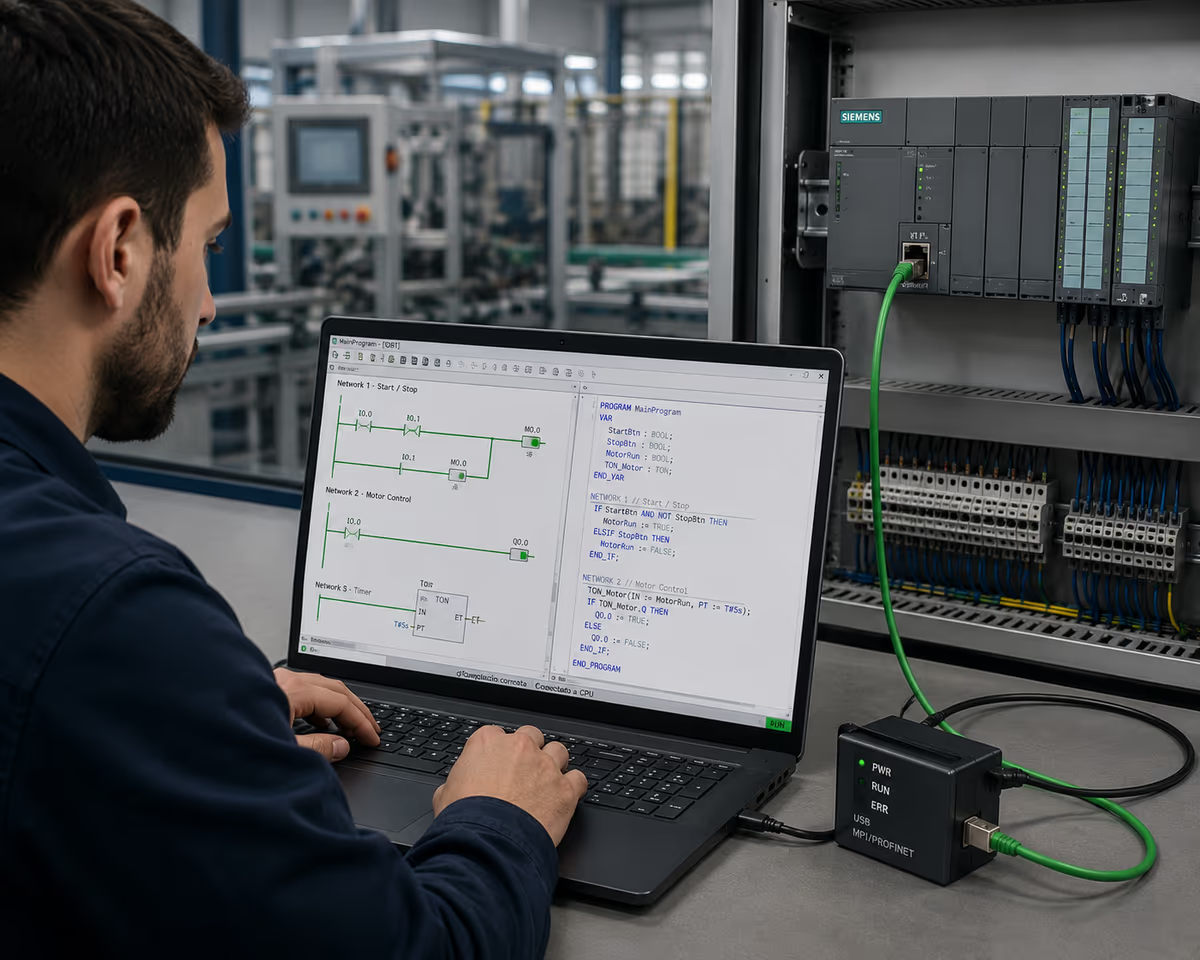
How much does PLC programming cost? Real prices 2026
· by Panayot Dimkov
If you are collecting quotes to automate a machine or refurbish a line, the first question is always the same: how much does PLC programming cost? Here are real market figures from Spain, what that price includes (or should include) and which factors push it up or down.
How much does it cost to program a PLC?
Programming a PLC costs between €3,000 and over €25,000 depending on project size, with engineering rates of €65–110 per hour in Spain. A small project (simple machine, a few dozen I/O) runs around €3,000–8,000; a mid-size one (line or process with communications and HMI), €8,000–25,000; and a complex one with SCADA, functional safety and several stations exceeds €25,000.
These ranges are orientative and come from our experience as system integrators: every plant, every process and every starting point is different. But they serve the important purpose: spotting both the inflated offer and the suspiciously cheap one. This table sums up the three scenarios:
| Project type | Typical scope | Price range |
|---|---|---|
| Small | Simple machine, 20–80 I/O, no SCADA, basic HMI | €3,000 – 8,000 |
| Medium | Line or process, 80–300 I/O, communications, full HMI | €8,000 – 25,000 |
| Complex | Several stations, 300+ I/O, SCADA, safety, recipes | €25,000 or more |
1 What PLC programming (really) includes
"Programming a PLC" is not sitting down to write code on day one. In a professional project, code is just one of five phases — and not the longest one:
As a rule of thumb, pure coding rarely exceeds 40% of the project hours; analysis, testing and documentation take the rest. That is why a very cheap offer almost always cuts corners there: in what you don't see on day one but pay for over the whole life of the machine.
2 The factors that move the price
Two machines with the same PLC can cost twice as much one as the other. These are the factors that really move the budget:
Number of I/O and process complexity
Inputs/outputs are the quickest thermometer of project size: every signal must be defined, wired into the program, tested and documented. But careful: 50 I/O of a process with recipes, dosing and traceability take more work than 150 I/O of on/off conveyors. The complexity of the logic weighs more than the raw count.
Functional safety (ISO 13849-1)
If the machine poses risks to people —and almost all do—, the safety circuit must be designed and validated according to ISO 13849-1: required performance level (PL), emergency stop functions, door interlocks, safety PLCs or relays. It adds engineering hours and specific hardware, but it is not optional: it is CE marking.
Communications and integration
An isolated PLC is increasingly rare: it must be integrated with drives over Profinet, with scales or analysers over Modbus, with the SCADA over OPC UA, sometimes with the ERP. Every gateway and every protocol adds configuration and testing hours. If you are unsure about the control and supervision layers, our comparison SCADA vs PLC makes it clear.
Retrofit vs new machine
Programming a new machine means starting from a blank page. A retrofit —replacing an obsolete PLC while keeping the machine— requires reverse-engineering an old program, often undocumented, and living with inherited wiring. That is why a retrofit can cost as much or more in engineering than a new project, even though it saves a lot on mechanics. If your project is a full line, see our guide on how much it costs to automate a production line.
Deadlines and site conditions
One factor everyone forgets until the end: the calendar. Commissioning during a two-day plant shutdown, working nights so production does not stop, or travelling to a remote site all add hours and surcharges that a comfortable schedule avoids. If your window is a summer or Christmas shutdown, close the offer months earlier: booking automation engineers at the last minute is as expensive as booking flights that way.
3 Siemens or Allen-Bradley? What changes in the price
It is the star question, and the honest answer is: in engineering hours, almost nothing. A good programmer takes about the same time to solve the same process in TIA Portal (Siemens) as in Studio 5000 (Allen-Bradley/Rockwell). What does change is the environment:
| Item | Siemens | Allen-Bradley |
|---|---|---|
| Development environment | TIA Portal, licences per version and range | Studio 5000, licences per functionality tier |
| Hardware cost in Europe | Competitive, wide distribution | Generally higher, more limited distribution |
| Technician availability (Spain) | Very high: the de facto standard | Lower: can make support and emergencies pricier |
| Where it fits best | European plants, Profinet ecosystem | American multinationals, EtherNet/IP corporate standard |
Our advice is neutral: if your group already has a corporate standard, stick to it — the maintenance savings outweigh any licence difference. If you are starting from scratch in Spain, the Siemens ecosystem usually works out cheaper thanks to the availability of spares and programmers.
4 Why documented code is worth more (and cheap turns out expensive)
Two programs can run the same machine and be worth a fraction of each other… five years later. A structured, commented program lets any technician diagnose a fault at 3 a.m. without calling the author; a "spaghetti" one turns every stoppage into a forensic investigation.
Documented code costs more hours today, but it is the difference between a 20-minute stop and a 4-hour one for the entire life of the machine. When comparing offers, always ask: is the code delivered commented and with a backup? Is there an alarm manual? Does the naming follow a standard? If the answer is vague, you will pay the initial saving back with every breakdown. It is the same logic we apply in our industrial process automation projects: the program is a plant asset, not a supplier's black box.
5 Warning signs of a poor quote
Before signing, run the offer through this list. Every failed point is a disguised extra cost:
- No functional analysis up front: if nobody writes down how the machine must work, you will pay for the commissioning "surprises" as extras.
- The scope fits in one line: "PLC and HMI programming" without an I/O list, operating modes or test protocols is not a scope — it is a blank cheque.
- No mention of safety: if the offer says nothing about ISO 13849-1 or safety validation, either the machine doesn't need it (rare) or someone is ignoring it.
- Documentation is "optional": uncommented code with no manual means lifelong dependency on the supplier.
- No defined warranty or support: who responds, within what time and at what rate when something fails after three months?
- The price is too good: below market rate nobody gives hours away; they cut them from testing and documentation — exactly what protects you.
Frequently asked questions
How much does programming a small PLC cost?
A small project —a simple machine with a few dozen I/O, no SCADA— usually costs between €3,000 and €8,000 in Spain, based on our experience at Nexum Automatics. It includes functional analysis, programming, commissioning and basic documentation.
How much does a PLC programmer charge per hour?
In Spain, the usual automation engineering rate ranges from €65 to €110 per hour, depending on the engineer's experience, the complexity of the process and whether the work is done in the office or at the machine; on-site commissioning runs between €95 and €130 per hour. Urgent or weekend call-outs usually carry a surcharge.
Is it more expensive to program a Siemens or an Allen-Bradley PLC?
The engineering cost is similar: the hours depend on the complexity of the process, not on the PLC's logo. The real difference lies in software licences, hardware and technician availability: in Europe the Siemens ecosystem is usually cheaper and easier to maintain; Allen-Bradley dominates in plants with American headquarters.
What should a PLC programming quote include?
At a minimum: a written functional analysis, the scope of I/O and communications, the programming standard, FAT/SAT testing, documentation (commented code, operation manual) and warranty and support terms. Distrust one-line quotes with no defined scope.
The bottom line
Programming a PLC costs between €3,000 and over €25,000 depending on scope, at rates of €65–110 per hour in Spain. The price is driven by I/O count, ISO 13849-1 safety, communications and whether it is a retrofit or a new machine — not by the PLC brand. And what separates a good investment from a chronic problem is not the figure, but having the scope, testing and documentation written into the offer.
See how we work in our industrial process automation projects.
Need a quote for your PLC programming?
Tell us which machine or process you want to automate and we will prepare an offer with detailed scope, testing and documentation included. No surprises.
Request a quoteNexum Blog
Related articles
25 Jun 2026
Industrial robot price: 2026 buyer's guide
How much does an industrial robot cost in 2026: arm price by type, brand, payload and reach, integration costs and ROI. A clear guide to budgeting.
18 Jun 2026
Robotic cell integration: cost breakdown
How much integrating a robotic cell costs: price breakdown by component, ranges by application and ROI. A 2026 guide from a robotic integrator.
31 Jul 2026
How to choose an industrial control panel manufacturer
How to choose an industrial control panel manufacturer: IEC 61439, FAT, in-house engineering, the 7 key questions and the red flags in cheap quotes.