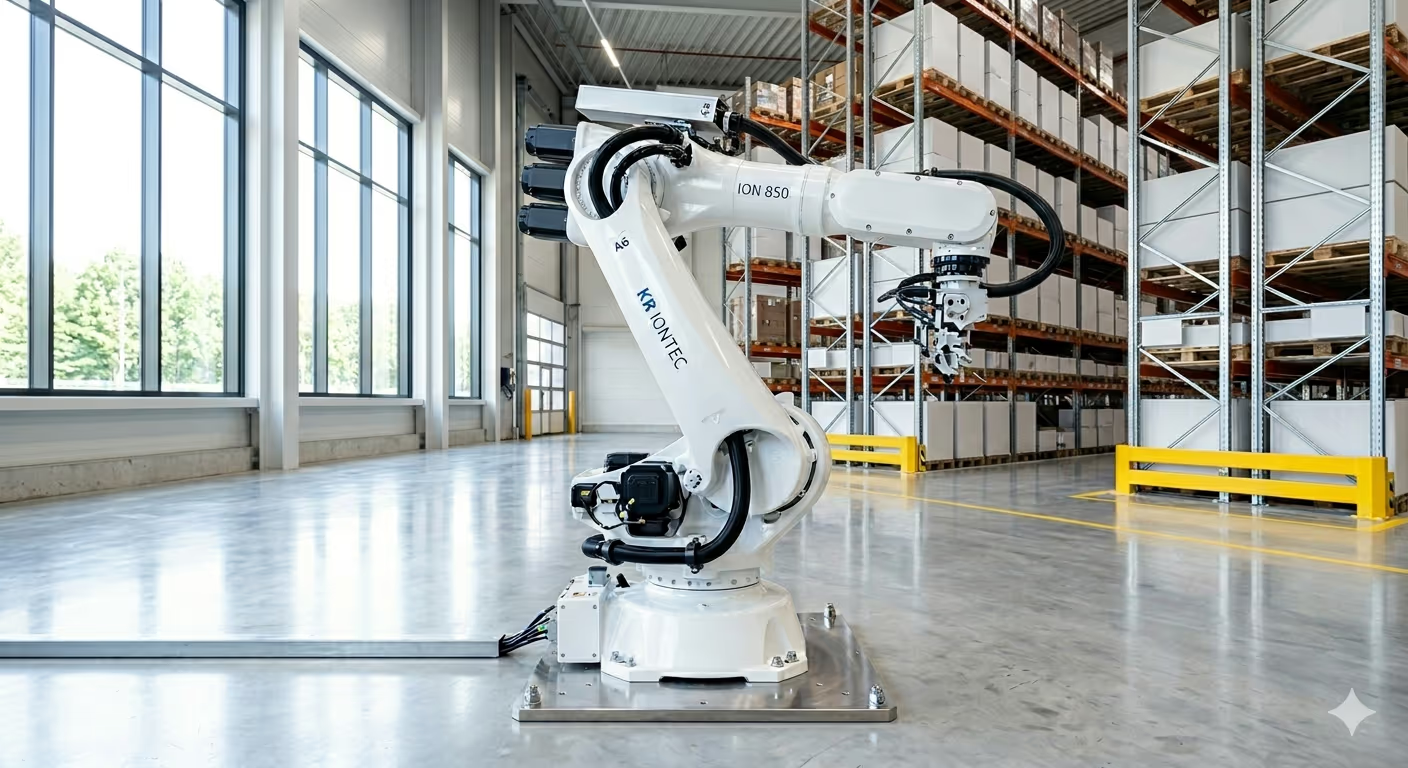
Industrial robot price: 2026 buyer's guide
· by Panayot Dimkov
How much does an industrial robot cost? The honest answer: the industrial robot price —the arm plus its controller— ranges from roughly €15,000 to over €150,000, but that figure is rarely what you pay in the end. This guide breaks down the price of the arm by type, brand, payload and reach, and shows where the rest of the budget actually goes.
1 Arm price vs. full-cell cost
The most expensive mistake when requesting a quote is confusing the industrial robot price with what it costs to automate your process. The manufacturer (FANUC, KUKA, ABB…) sells you an arm with its controller. But an arm alone can't pick, process or place a part: it needs tooling, safety, an electrical panel, programming and commissioning.
So separate two figures from the start:
2 Industrial robot price by type
The kinematic type is the first factor that moves the price. These are indicative ranges for the arm plus controller (new, not integrated):
| Robot type | Typical use | Arm price |
|---|---|---|
| Cobot (collaborative) | Light pick & place, machine tending next to people | €15,000–40,000 |
| SCARA | Fast 4-axis assembly and handling | €15,000–35,000 |
| Delta (parallel) | High-speed in-line pick & place | €25,000–60,000 |
| Cartesian / gantry | Palletising and handling on linear axes | €20,000–70,000 |
| 6-axis articulated | Welding, handling, machining, general use | €25,000–80,000 |
| High-payload 6-axis / palletiser | Heavy loads, end of line, intensive palletising | €60,000–150,000+ |
A cobot versus an industrial robot is not necessarily cheaper to buy, but it can save on safety by working alongside people without full fencing. That difference is paid in the cell, not in the arm.
3 How payload and reach affect the price
Within a single type, the two parameters that move the price most are payload and reach. More kilos at the wrist and more metres of reach demand sturdier motors, reducers and structure, and that raises the arm price directly.
| Payload | Typical reach | Indicative arm price |
|---|---|---|
| Up to 5 kg | 500–900 mm | €15,000–30,000 |
| 6–20 kg | 900–1,800 mm | €25,000–45,000 |
| 20–50 kg | 1,800–2,600 mm | €40,000–80,000 |
| 50–150 kg | 2,400–3,100 mm | €70,000–120,000 |
| 150–700 kg | 2,800–3,500 mm | €110,000–180,000+ |
4 Brands: what to expect from FANUC, KUKA, ABB, Yaskawa and UR
Brand affects price less than people think within the same payload segment, but it does define the ecosystem, support and spare-parts availability. Broadly:
The decision should rarely be made on brand alone. An independent robotic integrator picks the arm that best fits your part, cycle time and existing fleet, not the one that pays the most commission.
5 Added costs not in the arm price
This is where the budget multiplies. None of these are in the robot's list price, but all are essential to produce:
- Tooling (EOAT): gripper, vacuum cup, custom jaw or spindle. From €1,500 standard to €30,000+ custom.
- Safety and fencing: guards, laser scanners, light curtains, risk assessment and CE marking. €8,000–30,000.
- Machine vision: guidance or quality control. Typically adds €10,000–25,000 depending on complexity.
- Electrical panel and control: cabinet, PLC, drives and wiring that orchestrate the cell.
- Programming and engineering: design, simulation, commissioning and training. Usually 15–25% of the total.
To see how each euro of a complete installation is split, check the detailed breakdown in the cost of integrating a robotic cell.
6 New vs. refurbished and when it pays off
A refurbished robot can save up to 50–60% over a new one, and a reliable used arm can run at about half the cost. It's a sensible route for standard, well-proven tasks (palletising, machine tending) where the model is mature and spares exist. For critical processes, high cycle rates or long warranties, new still pays.
New or refurbished, the question that matters is the return (ROI). In palletising or machine-tending cells running multiple shifts, payback is usually under 2 years; with light cobots it can drop below 12 months. Labour savings, higher availability and consistent quality drive it. Reports from the International Federation of Robotics confirm this short-payback trend in industrial robotics.
Frequently asked questions
How much does an industrial robot cost?
The industrial robot price (arm plus controller, new and not integrated) ranges from about €15,000 for light cobots and SCARAs to over €150,000 for high-payload arms and palletisers. A general-purpose 6-axis articulated robot sits between €25,000 and €80,000. That price excludes tooling, safety and integration.
Why does the cell cost much more than the robot?
Because the arm is only 30–45% of a working installation. The rest is custom tooling (EOAT), safety fencing and CE marking, the electrical panel, machine vision and, above all, engineering and commissioning. For every euro of the arm, budget another €1.5–2.5 for integration.
Which type of industrial robot is cheapest?
Cobots and light SCARAs are the cheapest to buy (€15,000–35,000 for the arm), because they handle small payloads and are mechanically simpler. High-payload arms and 6-axis palletisers are the most expensive (€60,000–150,000+), due to the robustness that weight and reach demand.
How does payload affect the price?
It's one of the biggest factors: more kilos at the wrist demand sturdier motors, reducers and structure. An arm up to 5 kg runs €15,000–30,000; a 50–150 kg one rises to €70,000–120,000; and 150–700 kg arms exceed €110,000. Don't oversize: size to your real part.
Is it worth buying a refurbished robot?
For standard, well-proven tasks (palletising, machine tending) a refurbished robot saves 50–60% and pays back quickly, provided spares exist and the refurbishment is good. For critical processes, high cycle rates or long warranties, a new robot usually pays off.
How long does an industrial robot take to pay for itself?
In many palletising or machine-tending cells running several shifts, ROI is under 2 years, and with light cobots it can drop below 12 months. Labour savings, higher availability, lower scrap and consistent production quality all drive it.
In short
The industrial robot price is only the starting point: the arm costs between €15,000 and €150,000 depending on type, payload and brand, but the real cost is defined by the complete cell. Always request a quote for the robot and its integration, size to your real part and calculate the ROI with your own figures.
See how we approach it in our robotic installations.
Which robot do you need, and what would it cost?
Tell us your part, your cycle time and your task. We pick the right arm and give you a realistic quote for the complete cell, with its ROI.
Request a quoteNexum Blog
Related articles
24 Jun 2026
How much does a SCADA system cost?
How much a SCADA system costs in 2026: price ranges by size, cost factors (tags, licences, engineering), cloud vs on-premise, TCO and ROI explained.
2 Jul 2026
How to choose: FANUC vs KUKA vs ABB
How to choose a robot integrator and brand (FANUC vs KUKA vs ABB): criteria, certifications, key questions and red flags to check before you sign.

5 Oct 2026
Power Automate Pricing and Premium Connectors
Power Automate pricing explained: what Premium, Process and Hosted Process cost, when premium connectors kick in and how to keep the bill under control.