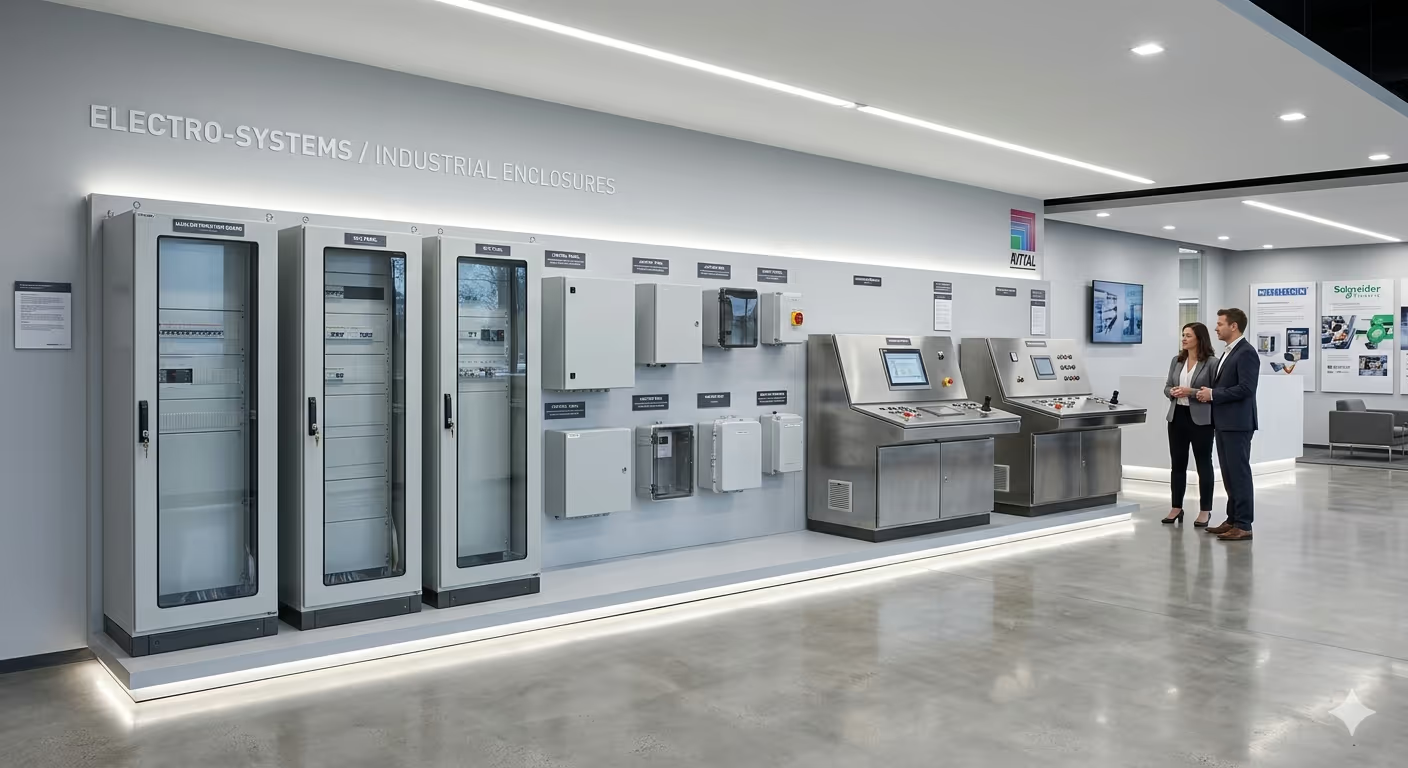
Types of Industrial Electrical Panels
· by Panayot Dimkov
Saying "electrical panel" in a plant is like saying "vehicle": the word means almost nothing until you specify what it does. Knowing the types of industrial electrical panels —from the main distribution board to the motor control center or the PLC control panel— is what lets you specify correctly, budget without surprises, and avoid installing an oversized unit where it is not needed or an undersized one where it matters. This guide organizes the full family by function, by mounting and by protection rating, and helps you choose the right one for your application.
1 The three main families by function
Before going into each type, keep one simple idea in mind. Any panel in a plant ultimately does one of three things: distribute power, start and protect motors or govern a process. That is the division that really matters, because it drives the design, the internal switchgear and even who engineers it.
In a real installation these functions blend —a control panel usually has its own auxiliary distribution, and a modern MCC carries intelligence— but classifying by the dominant function is what prevents confusion. Let's look at each type.
2 Distribution panels: LV switchboard and secondary boards
They are the electrical backbone of the plant. Their job is to receive power and distribute it protected to the rest of the installation, without governing any process.
Main low-voltage panel (LV switchboard)
The LV switchboard is the first panel after the transformer substation or the service entrance. It concentrates the main incomer, the main busbar and the outgoing feeders toward the secondary boards and large loads. It handles high currents, demands a well-calculated busbar and is usually the most critical asset of the installation: if the LV switchboard fails, the plant stops.
Secondary distribution boards
They hang off the LV switchboard and are the last link in distribution before the final loads: they feed a building, a line, a workshop or a floor. They distribute lighting, socket and small power circuits, with their MCBs and RCDs. They are the most numerous and the ones maintenance handles every day.
3 Motor control center (MCC)
When an installation has many motors —pumps, fans, conveyors, agitators— building a standalone panel for each becomes unmanageable. The answer is the motor control center (MCC): a modular, compartmentalized structure that groups the starting, command and protection of all those motors into a single assembly.
Each motor occupies a drawer or bucket, often withdrawable, with its own outgoer: motor protector or breaker, contactor and, where applicable, soft starter or variable-frequency drive. This drawer architecture is what gives the MCC its advantages over isolated panels:
- Centralized operation: all motors in one place, with a uniform scheme.
- Fast maintenance: a drawer is replaced —in many designs without de-energizing the rest— with no rewiring.
- Scalability: expanding means adding drawers to columns provisioned for it.
- Safety: compartmentalization limits the reach of a fault and eases isolation.
The MCC is the standard in pumping stations, wastewater plants, cement works, chemical plants and any production line with a large motor fleet. The trade-off is cost and size: for two or three motors it is not justified; from a dozen on, it almost always is.
4 Control, automation and switching panels
This is where the plant's "intelligence" sits. These panels do not just distribute or start: they decide what happens based on signals and logic. It is worth distinguishing two levels.
The practical boundary is clear: if the sequence is fixed and simple, a switching panel with hard-wired logic is the most economical option. As soon as recipes, alarms, traceability or the need to change behavior in software appear, the PLC control panel wins. We develop this in our electrical panels and industrial control service.
5 Power panels and field cabinets
To complete the taxonomy by function, two less-cited types appear in any plant:
In environments with an explosion risk, both these cabinets and control panels adopt a special certified variant: that is where ATEX electrical panels for hazardous areas come in, with their Ex protection modes.
6 Classification by mounting
Beyond their function, panels are also classified by how they are mounted, which determines space, accessibility and enclosure cost:
| Type | Mounting | When it is used |
|---|---|---|
| Wall-mounted | Hung on a wall | Small and medium panels: secondary, switching, single-machine control. Saves floor space. |
| Floor-standing (cabinet) | Stands on the floor | Large, heavy panels: LV switchboard, MCC, line control. More volume and busbar. |
| Modular / multi-cabinet | Juxtaposed cabinets | Very large, expandable assemblies: extensive MCCs, electrical rooms. Grows by columns. |
| Desk / console | Operator console | Machine operating stations, with HMI and controls at operator height. |
The same control panel can be wall-mounted on a compact machine or floor-standing on a full line: mounting is independent of function and is decided by size, weight and ergonomics.
7 IP and IK protection ratings
The last classification axis is the enclosure: how much it protects the interior from the environment. It is expressed with two standardized codes that should not be confused:
- IP rating (IEC 60529): protection against ingress of solids and water. The first digit (0-6) is dust; the second (0-9) is water. An IP65 is dust-tight and resists water jets.
- IK rating (IEC 62262): resistance to mechanical impacts, from IK00 to IK10, by the energy of the impact it withstands.
The rule of thumb: in a clean indoor area IP54-IP55 is enough; in dusty or hose-down zones IP65-IP66 is required; outdoors a minimum of IP54-IP55, often more. For impacts, IK08-IK10 in walkways or forklift areas. Wiring codes require matching the rating to the external influences of each location.
8 How to choose the panel type for your application
With the taxonomy clear, the choice comes down to answering a few questions in order. This is the logic we follow when specifying:
Solving these four layers in order avoids the most expensive mistake: specifying by catalog instead of by process. Power, number of motors, automation level and ambient conditions together determine the panel type. If you want to dig into the cost of building one or its renovation, we cover those separately.
Frequently asked questions
How many types of industrial electrical panels are there?
By function there are mainly six: the main low-voltage panel (LV switchboard), secondary distribution boards, motor control centers (MCC), control and automation panels (with PLC and HMI), power panels and switching panels. Add to those field or instrumentation cabinets. By mounting they are also classified as wall-mounted, floor-standing and modular, and by their IP/IK protection rating.
What is the difference between a distribution board and a control panel?
A distribution board splits and protects power across circuits (lighting, sockets, feeders) using breakers and protections; its job is to distribute power safely. A control panel governs a process: it houses a PLC, an HMI, relays, drives and the logic that coordinates sensors and actuators. In short, the distribution board distributes energy and the control panel makes decisions about the machine or process.
What is a motor control center (MCC)?
An MCC is a modular, compartmentalized assembly that groups the starting, command and protection of several motors in one structure. Each motor occupies a withdrawable drawer with its motor-protective device, contactor or soft starter or drive. Versus standalone panels, it centralizes operation, simplifies maintenance (hot-swappable drawers) and is the standard in plants with many motors: pumping, water treatment, cement or process lines.
What IP/IK rating does an industrial electrical panel need?
It depends on the environment. In a clean indoor area IP54-IP55 is usually enough; in dusty or hose-down zones IP65-IP66 is required, and outdoors a minimum of IP54-IP55 (often more). The IK index measures impact resistance: IK08-IK10 for areas with a risk of knocks. Electrical codes require matching the rating to the external influences per standards IEC 60529 (IP) and IEC 62262 (IK).
Which type of electrical panel do I need for my installation?
It depends on the function: to distribute power in the plant, an LV switchboard or secondary boards; to start and protect many motors, an MCC; to automate a machine or process, a control panel with PLC and HMI; for a pump or a simple hard-wired logic system, a switching panel. The choice is finalized by the power, number of motors, automation level and the IP/IK rating the environment demands. The most reliable path is to start from a process analysis with an integrator.
In short
The types of industrial electrical panels sort along three axes: by function (distribution, power/MCC and control), by mounting (wall, floor, modular, console) and by protection rating IP/IK. Getting it right is not about picking the "most complete" panel, but the one matching the dominant function, the automation level and the real environment of the installation.
If you need to specify, renovate or build a panel and are unsure which family your case belongs to, we start from the process —not the catalog— in our custom electrical panels.
Not sure which panel type you need?
Tell us about your installation: power, number of motors, automation level and environment. We will tell you which panel type fits, design it and build it to standard.
Talk to an expertNexum Blog
Related articles
31 Jul 2026
How to choose an industrial control panel manufacturer
How to choose an industrial control panel manufacturer: IEC 61439, FAT, in-house engineering, the 7 key questions and the red flags in cheap quotes.

15 Jun 2026
Machine vision for industrial quality control
What machine vision for quality control is, how it works, types of systems and how to justify the investment in your industrial production line.

7 Oct 2026
Process Automation ROI: How to Calculate It
How to calculate process automation ROI for admin work with your own data: what to measure first, which costs get forgotten and how to check it afterwards.