ATEX Electrical Panels: Hazardous Area Guide
· by Panayot Dimkov
In a refinery, a chemical plant, a grain silo or a paint booth, an ordinary control panel can become the spark that triggers an explosion. That is why ATEX electrical panels exist: enclosures and equipment certified to be installed in hazardous areas without becoming a source of ignition. This guide explains how those areas are classified, what the Ex marking and the protection modes mean, and how a panel for an explosive atmosphere is designed and certified.
1 What ATEX is and what an explosive atmosphere is
ATEX comes from the French ATmosphères EXplosibles and names the European framework that regulates equipment and workplaces where an explosive atmosphere may form: a mixture of air with flammable substances —gases, vapours, mists or combustible dust— that, once ignited, propagates combustion throughout the mixture.
For an explosion to occur, three factors must coincide —the "fire triangle" applied to explosion risk: fuel (flammable gas or dust), oxidiser (the oxygen in the air) and a source of ignition (a spark, an electric arc or a hot surface). The electrical panel is, potentially, that third leg. The goal of ATEX is to remove it: no electrical equipment installed in the area should be able to generate enough energy to ignite the mixture.
2 ATEX zone classification: gas and dust
Before choosing any equipment you must classify the area: define where, how often and for how long an explosive atmosphere may be present. That classification is the responsibility of the site operator and is documented in the Explosion Protection Document. There are two families —gases and dusts— and, within each, three zones according to the likelihood of presence.
| Zone | Substance | Presence of explosive atmosphere | Equipment category |
|---|---|---|---|
| 0 | Gas / vapour | Continuous, frequent or long-term | Category 1G |
| 1 | Gas / vapour | Likely in normal operation | Category 2G |
| 2 | Gas / vapour | Unlikely and short-lived | Category 3G |
| 20 | Combustible dust | Continuous, frequent or long-term | Category 1D |
| 21 | Combustible dust | Likely in normal operation | Category 2D |
| 22 | Combustible dust | Unlikely and short-lived | Category 3D |
The logic is straightforward: the more likely the explosive atmosphere, the more demanding the equipment. Zone 0 (inside a solvent tank) and Zone 20 (inside a flour or sugar silo) are the most critical and require category 1 equipment with double protection. Zones 1/21 are typical around valves, pumps or loading points; Zones 2/22 are the low, occasional-risk areas. A panel meant for Zone 2 is not valid for Zone 1, let alone Zone 0.
3 Ex marking: how to read an ATEX equipment label
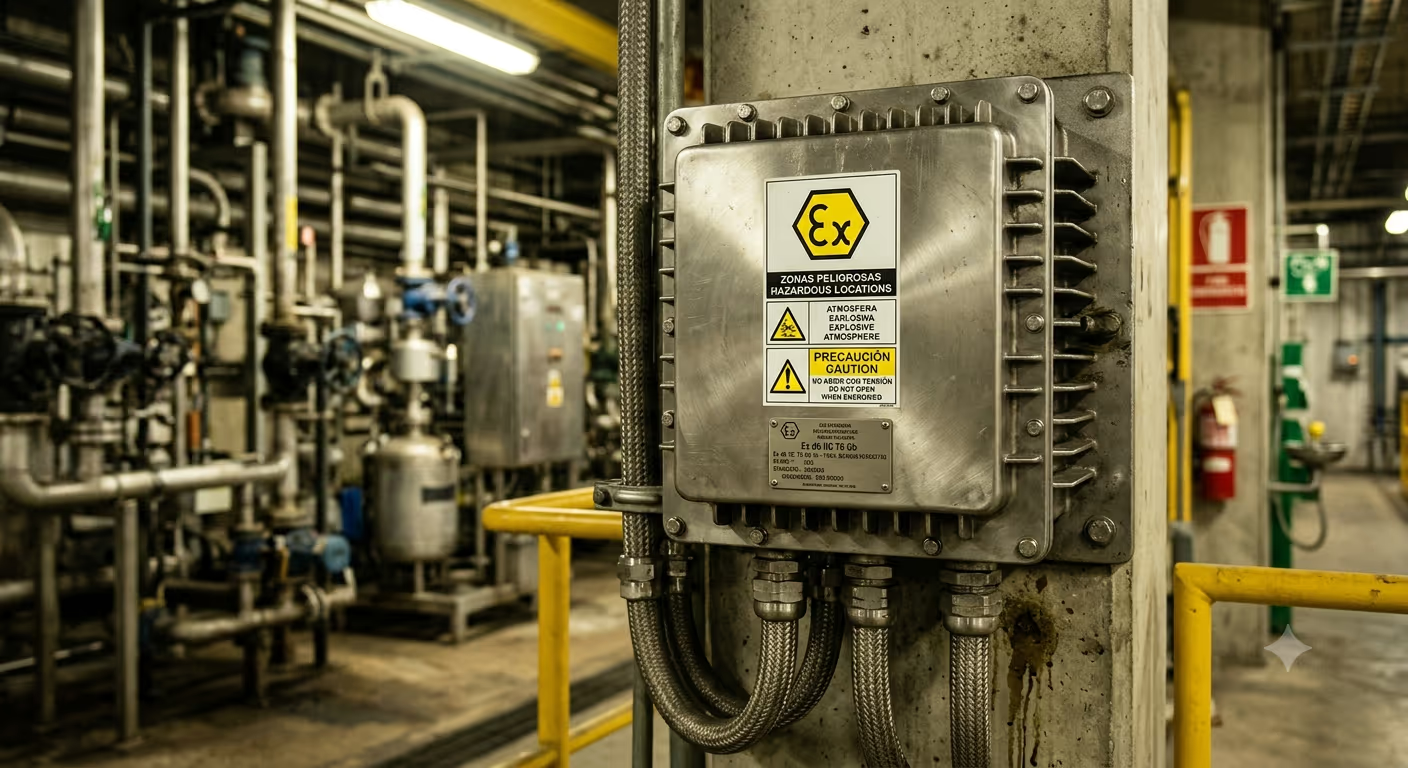
Every certified piece of equipment carries the Ex marking: the "Ex" inside a hexagon next to the CE mark and a sequence of codes that states which zone it is fit for. Knowing how to read it avoids the most expensive mistake: installing equipment that is valid but of an insufficient category for the zone.
A typical marking, such as ❳Ex❴ II 2 G Ex db IIB T4 Gb, breaks down like this:
- Equipment group: I for mining (firedamp) · II for surface industry.
- Category: 1, 2 or 3, linked to the zone (1 → Zone 0/20, 2 → Zone 1/21, 3 → Zone 2/22).
- Atmosphere type: G (gas) or D (dust).
- Protection mode:
db,eb,px,ia… (see section 4). - Gas group (IIA / IIB / IIC) and temperature class (T1 to T6, with T6 ≤ 85 °C the most restrictive).
4 Ex protection modes: how a panel is "armoured"
There is no single way to make electrical equipment safe in a hazardous area. There are several Ex protection modes, defined by the EN/IEC 60079 series of standards, and an ATEX panel usually combines two or three. These are the most common in panels and enclosures:
In practice, a control panel for Zone 1 can be solved with a flameproof Ex d enclosure housing conventional switchgear, or with an increased-safety Ex e box that only accepts certified components. When the panel is large or dissipates a lot of heat, pressurization Ex p is usually the most practical option, because it allows standard switchgear inside an enclosure monitored by a pressure control system. Field instrumentation and signals are almost always protected by intrinsic safety Ex i.
5 The regulatory framework: 2014/34/EU and workplace ATEX
ATEX is not a single standard but two complementary European directives that should not be confused, because they split responsibilities between the equipment manufacturer and the plant operator:
For equipment, the technical basis is the EN/IEC 60079 series (general requirements, flameproof 60079-1, increased safety 60079-7, pressurization 60079-2, intrinsic safety 60079-11, dust 60079-31…). Meeting these harmonised standards gives a presumption of conformity with the directive. You can review the official framework at the European Commission ATEX portal.
6 How a panel for a hazardous area is designed and certified
Building an ATEX panel is not assembling a standard one and "approving" it afterwards. Compliance is built from the very first drawing. The process, in short:
It helps to separate two planes: the enclosure and components (which arrive already certified from the manufacturer) and the final assembly, where the integrator is responsible for ensuring that the build, the cable entries, the clearances and the heat dissipation respect the certificate conditions. Getting this wrong is the most common failure.
7 Common mistakes when specifying an ATEX panel
Most incidents do not come from defective equipment but from specification decisions taken lightly. The most frequent:
- Misclassifying the zone or not classifying it: category 3 equipment (Zone 2) is chosen for an actual Zone 1.
- Ignoring the temperature class: the protection mode is correct, but the hot surface exceeds the auto-ignition point of the dust present.
- Mixing gas and dust: equipment valid for gas (G) does not protect against combustible dust (D), which requires sealing against particle ingress.
- Fitting non-certified components inside an Ex e enclosure, or using unsuitable cable glands that break the flameproof mode.
- Forgetting Ex maintenance: periodic inspections (EN/IEC 60079-17) are mandatory; a neglected ATEX panel stops being one.
Frequently asked questions
What is an ATEX electrical panel?
It is a control or power panel designed and certified to Directive 2014/34/EU to be installed in areas with explosive atmospheres (gas or dust) without becoming a source of ignition. Unlike a conventional panel, it guarantees that neither in normal operation nor in a fault will it generate a spark, arc or temperature capable of igniting the mixture, by means of an Ex protection mode (flameproof, increased safety, pressurization or intrinsic safety).
How are ATEX zones classified?
By the likelihood and duration of the explosive atmosphere. For gases and vapours: Zone 0 (continuous or frequent presence), Zone 1 (likely in normal operation) and Zone 2 (unlikely and short-lived). For combustible dusts the equivalents are Zones 20, 21 and 22. Each zone requires an equipment category: 1 for Zone 0/20, 2 for Zone 1/21 and 3 for Zone 2/22.
What do the Ex d, Ex e, Ex p and Ex i protection modes mean?
They are different ways of making equipment safe. Ex d (flameproof) confines the explosion inside an enclosure that does not transmit it outside. Ex e (increased safety) applies constructive measures to prevent sparks. Ex p (pressurization) keeps the interior at overpressure so the explosive atmosphere cannot enter. Ex i (intrinsic safety) limits the circuit energy below the ignition threshold, typical of instrumentation.
What is the difference between Directive 2014/34/EU and ATEX 153?
Directive 2014/34/EU (ATEX 114 or "product") regulates the design, manufacture and marketing of equipment for explosive atmospheres and requires the Ex marking. Directive 1999/92/EC (ATEX 153 or "workplace") requires the employer to assess the risk, classify the zones and draw up the Explosion Protection Document for the site.
Do I need to certify an electrical panel for an ATEX zone?
Yes. Any electrical equipment installed in an ATEX zone must be certified for the relevant category and carry the Ex marking. Depending on the category, it may require the involvement of a Notified Body, the EU declaration of conformity and a technical file. In addition, the assembly must respect the certificate conditions during installation (cable entries, clearances, dissipation) and undergo the periodic inspections required by EN/IEC 60079-17.
The bottom line
An ATEX electrical panel is defined by the zone it will live in: the classification (0/1/2 or 20/21/22) fixes the equipment category, the Ex protection mode and the allowable temperature class. Getting it right means starting from the zone classification, not from the catalogue, and respecting both Directive 2014/34/EU for the equipment and the workplace ATEX directive for the site.
If you have a hazardous area to automate or a panel to renew, see how we approach it in our custom electrical panels.
A hazardous area to electrify with full guarantees?
Tell us your zone classification, the substances present and your process. We design, build and certify the panel your explosive atmosphere needs, with the file that backs it.
Talk to an expertNexum Blog
Related articles

9 Oct 2026
Mandatory B2B E-Invoicing in Spain: What to Do
Mandatory B2B e-invoicing in Spain now has its regulation: expected dates, how it differs from Verifactu and how to prepare while automating.
12 Aug 2026
Industrial control panel design: phases and costly mistakes
Industrial electrical panel design in 5 phases: specification, EPLAN schematics, thermal sizing, IEC 61439 and documentation. An integrator's guide.
6 Aug 2026
Robot cell safety standards: CE marking guide 2026
Which standards a robot cell must meet: EN ISO 10218, ISO/TS 15066, EN 60204-1, CE marking and who is responsible. A practical integrator's guide.