Industrial control panel design: phases and costly mistakes
· by Panayot Dimkov
Industrial control panel design is the part of the project you never see on the shop floor, yet it decides whether the panel will run for twenty years without surprises or cause trouble from day one. A well-assembled enclosure built on a poor design is still a poor panel. Here we walk you, phase by phase, through how an industrial electrical panel is really designed and what you should demand from the engineering firm that signs it.
How is an industrial electrical panel designed?
The professional process is always the same, whether the panel is for distribution, machine control or process control: first you establish what it must do and under which conditions (specification), then you translate that into schematics, then you size components, heat management and protections, verify the assembly against IEC 61439, and finally produce the documentation that will accompany the panel for its whole life.
1 Specification: the input data is everything
Every badly designed panel starts with an incomplete specification. Before drawing a single line you must establish: the load list with powers, starting methods and simultaneity; the prospective short-circuit current at the connection point; the environment (temperature, dust, humidity, explosive atmospheres, which demand their own approach); the IP and IK protection ratings; the earthing system; and the space and power reserves the future will ask for.
This phase is also where the architecture is decided: one main board plus sub-boards, or a single process cabinet? Internal compartmentalisation (forms 1 to 4) according to criticality? A good integrator spends this phase asking the uncomfortable questions — what will grow, what will be shut down for maintenance, who will operate it — because changing an architectural decision at the schematics stage costs ten times more, and in the field, a hundred times more.
2 Schematics: EPLAN or AutoCAD Electrical, never "workshop sketches"
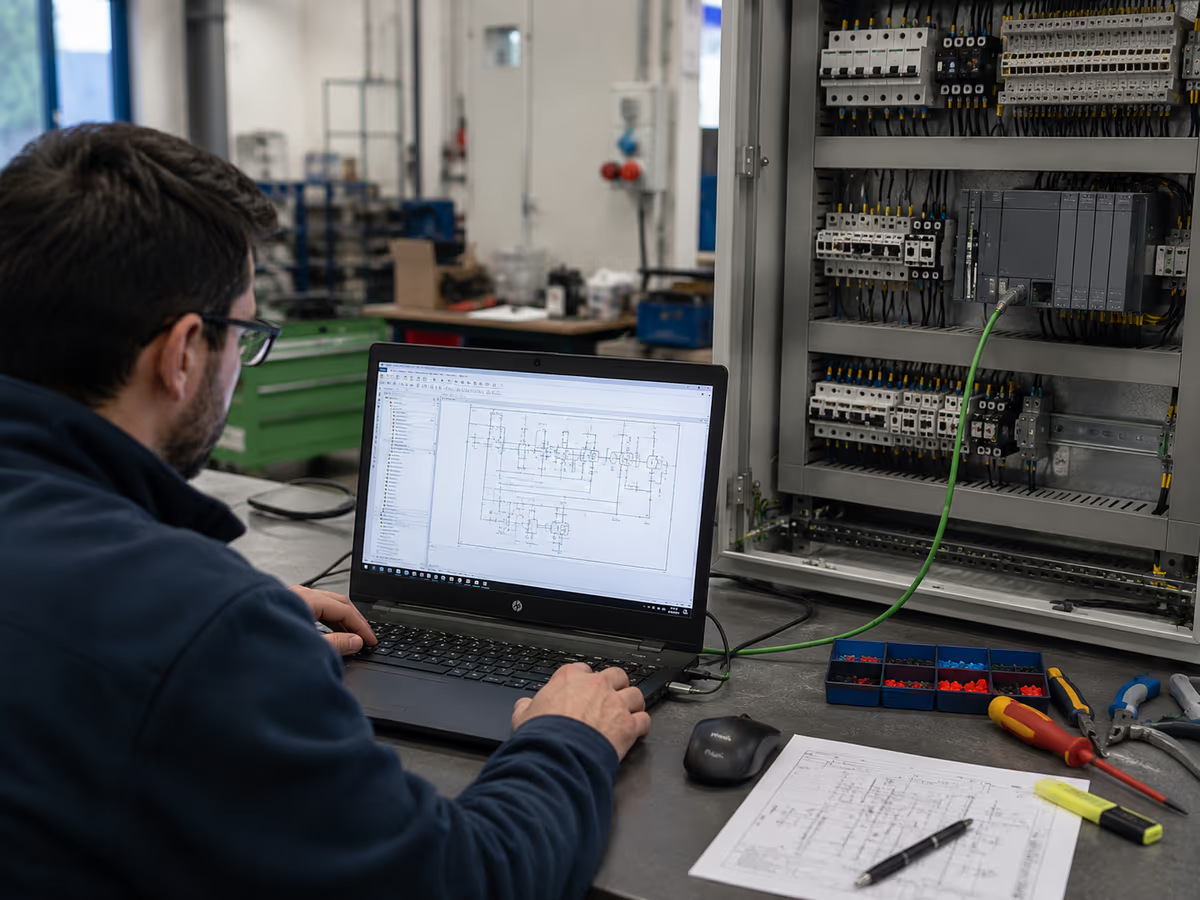
With the specification closed, the electrical schematics are developed: the power single-line diagram, control multi-line diagrams, terminal diagrams and wiring lists. The reference tools are EPLAN Electric P8 and AutoCAD Electrical — not out of fashion, but because they work with databases of real components, number wires and terminals automatically, and generate bills of material consistent with the drawing.
That has a practical consequence the client notices years later: when the schematic is made in a proper electrical CAE tool, any future modification — adding a drive, extending a line — starts from a reliable base. A panel documented with generic drawings or, worse, with outdated schematics, turns every breakdown into an archaeology session with a multimeter.
3 Thermal and protection sizing
This is the most technical phase and the one that separates a professional panel from a box with components. It includes three calculations that must be documented:
- Thermal calculation: all the power dissipated by breakers, drives, power supplies and busbars ends up as heat inside the cabinet. The expected internal temperature is calculated and a decision is made on whether natural ventilation is enough or forced fans or air conditioning are needed. A panel running at 55 °C inside ages its components at twice the speed.
- Busbar and cable sizing: cross-sections by current-carrying capacity and by short-circuit stresses, with balanced phase distribution and properly sized tap-offs.
- Protection coordination: each protective device must withstand and break the short-circuit current at its point, and the whole must be selective: a fault on one outgoing feeder must trip that feeder, not the main breaker that leaves the entire plant in the dark. Selectivity and cascading are verified with the manufacturer's tables, not by eye.
4 Verification to IEC 61439
The IEC 61439 standard is the framework that turns "a cabinet with components" into a verified switchgear and controlgear assembly. It defines two roles: the original manufacturer (who designs and verifies the system, usually on an enclosure manufacturer's platform) and the assembly manufacturer (who builds and tests the specific panel). Design verification covers temperature rise, short-circuit withstand, insulation distances, IP rating and earth continuity; and every panel built additionally passes its routine verification tests before leaving the workshop.
For the buyer, the summary is simple: demand that the panel is declared compliant with IEC 61439 and that the tests are documented. We have a full guide on the IEC 61439 standard for electrical panels, and the official text is available from the IEC (International Electrotechnical Commission).
5 Documentation: what accompanies the panel for life
The last phase is the most often skimped — and the most appreciated five years later. A serious documentation package includes the as-built schematics (as it was actually built, not as it was first drawn), the thermal and short-circuit calculation notes, the test certificates, the CE declaration of conformity, and the operating and maintenance instructions.
What the engineering firm must hand over
Use this as a checklist when contracting the design of an industrial electrical panel. If any of this is missing, the job isn't finished:
- Complete single-line and multi-line schematics in EPLAN or AutoCAD Electrical, with native files and PDF.
- Bill of materials (BOM) with exact manufacturer references.
- Thermal calculation and justification of the chosen ventilation or cooling.
- Short-circuit and selectivity study with the coordination tables applied.
- Cabinet layout drawing: arrangement of devices, terminals and trunking.
- Declaration of conformity (IEC 61439, CE marking) and routine test reports.
- Operation and maintenance manual with torque values and inspection schedule.
Design mistakes that cost dearly
Three mistakes account for most of the problems we find when we are called in to audit or refurbish panels built by others:
All three share the same origin: saving engineering hours. And all three share the same invoice: they are paid back multiplied over the panel's entire life — in energy, in downtime and in impossible expansions.
Design with maintenance in mind
A panel is designed once and maintained for decades, so the design must side with whoever will open it at three in the morning: complete labelling consistent with the schematics (every wire, terminal and component identified), clear access with real working space in front of the cabinet, trunking with margin to rework wiring, internal lighting and service sockets, and critical devices placed at a workable height, not behind other elements.
It is also the moment to decide what gets monitored: energy metering, thermal surveillance or protection statuses later integrated into the plant's control system. If the panel feeds an automated process, that dialogue between panel and control system must be designed now, not improvised at commissioning; that is how we approach it in our industrial electrical panels service.
How much does design weigh in the budget?
In a custom industrial panel, design engineering accounts for roughly 20% of the total budget — the rest is split between materials, switchgear, assembly labour and testing. It is tempting to cut exactly there, because it is the least tangible line item; but as we have seen, it is the one that determines the cost of all the others and the operating cost of the next twenty years. You will find the full breakdown of line items and ranges in how much it costs to build an industrial electrical panel.
The practical takeaway: between two offers, distrust the one that doesn't itemise the engineering. Cheap design doesn't disappear from the budget; it moves, with interest, to the maintenance bill.
Frequently asked questions
What are the phases of industrial electrical panel design?
Five: requirements specification (loads, environment, short-circuit level, reserves), electrical schematics in EPLAN or AutoCAD Electrical, thermal sizing and protection coordination, verification to IEC 61439, and final documentation with as-built schematics, calculations, certificates and a maintenance manual.
What documentation must the engineering firm deliver with the panel?
At minimum: single-line and multi-line schematics with native files, a bill of materials with references, the thermal calculation, the short-circuit and selectivity study, the cabinet layout drawing, the IEC 61439 declaration of conformity with test reports, and the operation and maintenance manual. Without that package, the panel isn't finished.
Which panel design mistakes are the most expensive?
Three: optimistic thermal calculation, which ages components and causes summer stoppages; lack of space reserves (a healthy figure is 20-30% free), which makes any expansion expensive; and unstudied selectivity, which lets a minor fault trip the main breaker and stop the whole plant.
How much does design weigh in the price of an electrical panel?
Around 20% of the total budget of a custom industrial panel; the rest goes to materials, switchgear, assembly and testing. Cutting engineering is a false economy: the design determines the cost of every other line item and the operating and maintenance cost of the next twenty years.
The bottom line
Designing an industrial electrical panel is a five-phase process where each phase protects the next: the specification avoids redesigns, professional schematics avoid future archaeology, proper sizing avoids thermal failures, IEC 61439 avoids legal surprises, and documentation avoids depending on anyone's memory. Demand all five — and demand to see them in writing.
See how we design and build industrial electrical panels at Nexum.
Need to design or refurbish an electrical panel?
Tell us what it feeds, in what environment it works and how much it has to grow. We'll come back with a proposal with full engineering: schematics, calculations, IEC 61439 verification and documentation.
Talk to an expertNexum Blog
Related articles

15 Jun 2026
Machine vision for industrial quality control
What machine vision for quality control is, how it works, types of systems and how to justify the investment in your industrial production line.

5 Oct 2026
Power Automate Pricing and Premium Connectors
Power Automate pricing explained: what Premium, Process and Hosted Process cost, when premium connectors kick in and how to keep the bill under control.
24 Mar 2026
What is a BMS system and how does it improve energy efficiency?
Discover what a BMS (Building Management System) is, how it works and how much it can reduce the energy consumption of your building or industrial facility. Practical guide for maintenance managers.