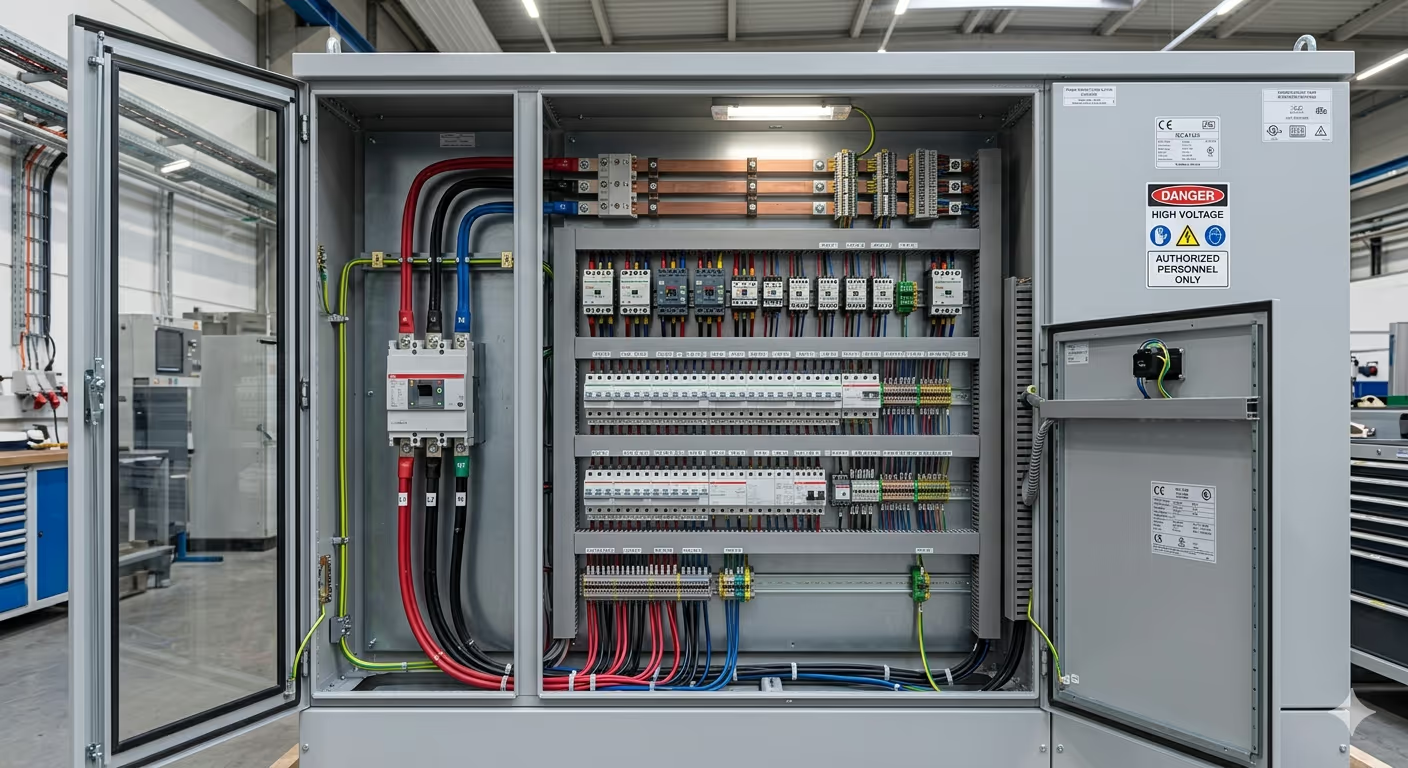
IEC 61439 explained: LV switchgear standard
· by Panayot Dimkov
If you specify, buy or maintain industrial electrical panels, IEC 61439 is the document that decides whether your low-voltage assembly is safe and compliant. It is not paperwork: it defines how you prove that a panel carries its current, withstands a short circuit and protects people. This technical guide explains what IEC 61439 is, what it replaced, the key difference between design verification and routine verification, and why it matters for your plant.
1What IEC 61439 is and what it replaced
IEC 61439 is the international standard that sets the requirements for low-voltage switchgear and controlgear assemblies —what we call electrical panels— for voltages not exceeding 1,000 V AC or 1,500 V DC. In Europe it is adopted as EN 61439, and it is the recognised route to presume conformity with the Low Voltage Directive and apply CE (or UKCA) marking to the assembly.
It replaced the former IEC 60439, and it was not a simple change of number. The 60439 distinguished between "type-tested" assemblies (TTA) and "partially type-tested" assemblies (PTTA). That boundary was ambiguous and opened the door to loose interpretations. IEC 61439 removes that distinction and requires every panel to pass a single set of verifications, regardless of who builds it or its size.
The core idea of IEC 61439 is simple: every panel must be verified, no shortcuts. What changes is how the verification work is split between whoever designs and whoever builds.
2The structure of the standard: part 1 and part 2
IEC 61439 is a family of documents. For an industrial distribution and control panel, the two parts that matter are:
| Part | Scope | What it applies to |
|---|---|---|
| IEC 61439-1 | General rules | Definitions, rated characteristics and the verifications common to all assemblies. Never used alone: it is the baseline. |
| IEC 61439-2 | Power switchgear (PSC) | Specific requirements for industrial power distribution and control panels. This is the part that applies to most plant panels. |
| IEC 61439-3 | Distribution boards (DBO) | Boards operated by ordinary persons (e.g. domestic or service boards). |
| IEC 61439-4 / -5 / -6 | Sites, public networks, busbars | Assemblies for construction sites, public distribution and prefabricated busbar trunking systems. |
Part 1 is never applied on its own: it defines the common framework. Part 2 —the relevant one for most industrial projects— completes it with the specifics of power assemblies. When someone says "panel compliant with 61439", in an industrial context they almost always mean 61439-1 + 61439-2.
3Design verification vs. routine verification
This is the central concept of the standard, and the one that causes most confusion. IEC 61439 requires two distinct levels of verification that are not interchangeable.
Design verification: three valid routes
Design verification does not force you to test everything in a laboratory. The standard allows three methods, which can be combined depending on the aspect being verified:
- Testing: subjecting a sample assembly to real tests (temperature rise, short circuit, dielectric strength…). The most robust method, used for the original manufacturer's base system.
- Calculation: verifying by calculation according to the rules of the standard (for example, temperature rise from verified-system data).
- Design rules: applying the standard's comparisons and criteria against an already verified reference design.
This is what makes the model workable: the original manufacturer tests its base system and publishes the limits; the assembly manufacturer builds within those limits and verifies by calculation or rules, without having to destroy a panel in a lab for every project.
Common mistake: assuming routine verification replaces design verification. It does not. A perfectly wired panel based on an unverified design is not compliant. You need both.
4The design verifications, one by one
IEC 61439-1 organises design verification into a list of checks covering construction and performance. These are the main ones any project owner should recognise:
| Verification | What it proves |
|---|---|
| Strength of materials and parts | Mechanical robustness, corrosion, heat and UV resistance of the enclosure. |
| Degree of protection IP / IK | Protection against ingress of solids, water and mechanical impact. |
| Clearances and creepage distances | Sufficient separation between live parts to avoid arcing and tracking. |
| Protection against electric shock and PE continuity | That exposed parts are bonded to the protective circuit and it is continuous. |
| Incorporation of switchgear and terminals | That components and external-conductor terminals are suitable. |
| Internal separation (Form) | The internal form of separation (1 to 4) between busbars, functions and terminals. |
| Dielectric properties | Power-frequency withstand voltage and lightning-impulse withstand. |
| Temperature-rise limits | That no component exceeds its admissible temperature in service. |
| Short-circuit withstand (Icw / Ipk) | That the assembly withstands the short-circuit current without dangerous damage. |
| Electromagnetic compatibility (EMC) | Immunity and emissions within limits for the intended environment. |
| Mechanical operation | That moving parts (doors, withdrawable units, interlocks) operate correctly. |
The verifications can be carried out in any order and using the method permitted in each case. What matters is that all of them are covered and documented before declaring the assembly compliant.
5Original manufacturer vs. assembly manufacturer
The standard splits responsibilities between two roles, and understanding who is who avoids legal and warranty surprises.
They can be the same company or two different ones. The decisive point: compliance of the final panel always rests with the assembly manufacturer, who signs. If you build outside the limits verified by the original —swapping components, pushing the temperature rise, altering the busbar layout— you become de facto the original manufacturer of that variant and must provide the corresponding design verification yourself.
That is why a serious integrator does not improvise: it works on verified systems of enclosure and switchgear, respects the original manufacturer's limits and documents every deviation. That is what separates a compliant panel from one that only looks like it.
6Rated characteristics: what your panel must declare
Compliance is made concrete in a rating label and technical documentation with rated values. These are the figures that guarantee the panel is sized for its real duty, not the catalogue one:
If you are going to specify or refurbish a panel, these are the values you must request and verify. To see how they fit into a real budget, our guide on how much an industrial electrical panel costs to build can help.
Frequently asked questions
What is the IEC 61439 standard?
It is the international standard that sets the requirements for low-voltage switchgear and controlgear assemblies (electrical panels) up to 1,000 V AC or 1,500 V DC. It replaced the former IEC 60439 and is adopted in Europe as EN 61439.
What is the difference between design verification and routine verification?
Design verification proves once, through testing, calculation or design rules, that the assembly model meets the standard. Routine verification is carried out on every panel built before it leaves the factory to confirm it is correctly assembled.
What is the difference between the original manufacturer and the assembly manufacturer?
The original manufacturer defines the design and supplies the design verifications. The assembly manufacturer builds the panel following those instructions and signs the routine verifications. Compliance of the final panel rests with the assembly manufacturer.
What is the difference between IEC 61439-1 and IEC 61439-2?
Part 1 sets the general rules common to all assemblies. Part 2 adds the specific requirements for power switchgear assemblies (PSC), which are the most common industrial distribution and control panels.
Is IEC 61439 mandatory for my electrical panel?
Yes. In the EU, meeting EN 61439 is the recognised route to presume conformity with the Low Voltage Directive and apply CE marking to the assembly. A panel without design verification should not be installed.
Which rated characteristics must the assembly manufacturer declare?
Among others: rated current (In), rated short-time withstand current (Icw), peak withstand current (Ipk), rated voltage, IP/IK protection degree and the internal form of separation. These figures guarantee the panel withstands its real duty.
The bottom line
IEC 61439 is not about bureaucracy: it is about proving, with documented verifications, that your panel withstands current, short circuit and protects people. Remember the two pillars: design verification (once, per model, by the original manufacturer) and routine verification (on every panel, by the assembly manufacturer), with the final conformity signed by the latter.
If you need a panel compliant with EN 61439 or an audit of an existing one, at Nexum we work on verified systems and complete documentation. You can consult the official text at the IEC or its European adoption via CENELEC.
Does your panel truly meet IEC 61439?
We design, build and audit low-voltage electrical panels compliant with EN 61439, with full design verification and documentation.
Talk to an expertNexum Blog
Related articles

8 Aug 2026
SCADA for SMEs: when it pays off and what it costs
SCADA for SMEs: from how many signals it pays off, what an entry project costs (€15,000–40,000), phases, typical mistakes and available grants.
31 Jul 2026
How to choose an industrial control panel manufacturer
How to choose an industrial control panel manufacturer: IEC 61439, FAT, in-house engineering, the 7 key questions and the red flags in cheap quotes.
3 Jul 2026
UKCA vs CE Marking for Control Panels
UKCA vs CE marking for electrical control panels: which directives apply, the real 2026 status and what you need to export panels to Great Britain.