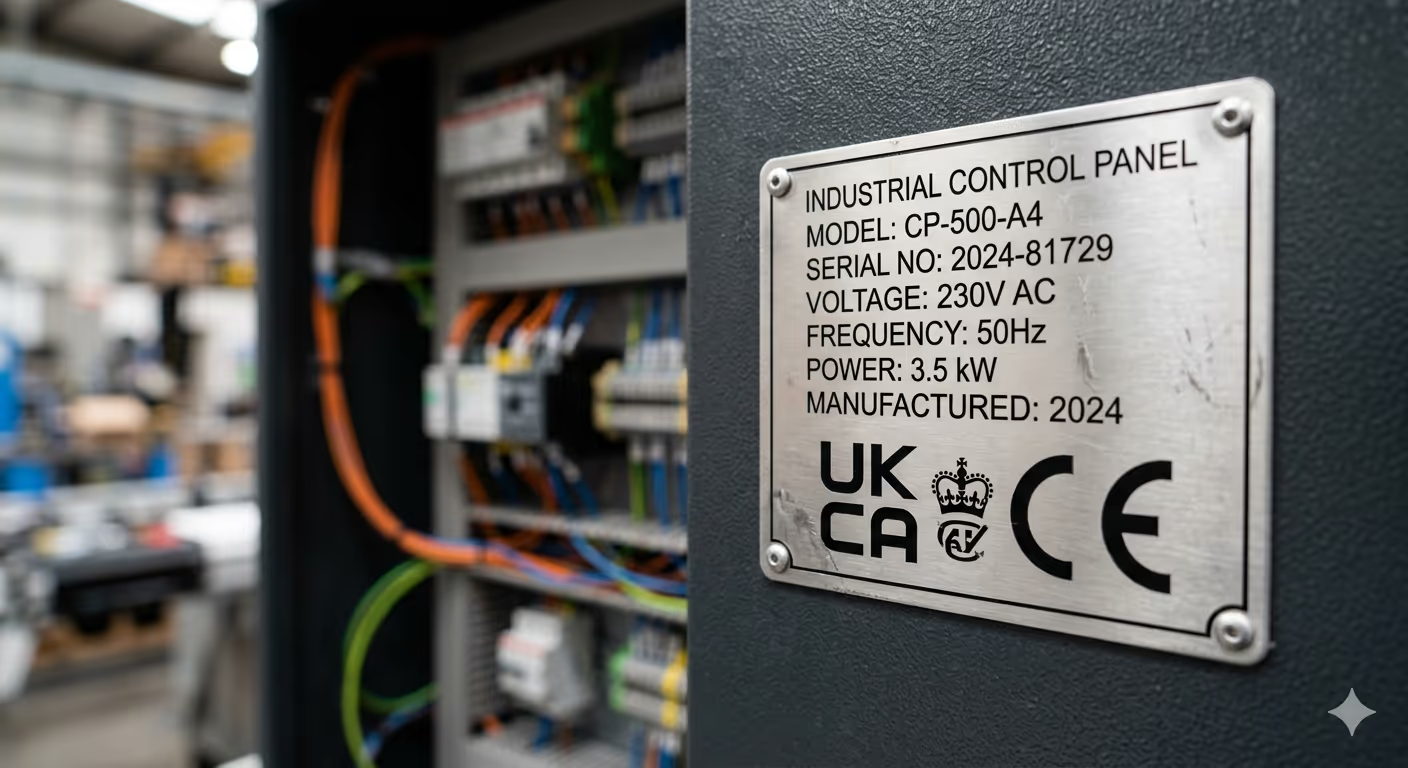
UKCA vs CE Marking for Control Panels
· by Panayot Dimkov
If you build electrical or control panels and sell (or want to sell) into the UK, the million-pound question is this: do I need UKCA marking on my control panels, or does CE marking still work? The answer has changed several times since Brexit, so here is the real 2026 status and exactly what to require to export control panels to Great Britain without surprises.
1What CE marking is and which directives apply to a panel
CE marking is not a quality seal or a certificate issued by a third party: it is the manufacturer's declaration that the product meets all the European directives that apply to it and that the relevant conformity-assessment procedure has been followed. For a low-voltage electrical or control panel, three directives come into play:
Technical compliance for the low-voltage part is demonstrated by designing the assembly to the product standard IEC 61439, which defines the panel's design and routine verifications. If you want to go deeper, we cover it in our guide on when to renew an industrial control panel.
CE marking of a panel is almost always by manufacturer self-declaration (module A): you do not need a Notified Body for most low-voltage panels. What you do need is the technical file that backs it up.
2What UKCA marking is and where it comes from
After Brexit, the UK created its own conformity system: UKCA (UK Conformity Assessed). The aim was to replace CE for products placed on the Great Britain market (England, Scotland and Wales; Northern Ireland has a separate regime). To do that, the UK "copied" the European directives into equivalent British regulations:
| EU directive (CE marking) | UK regulation (UKCA marking) |
|---|---|
| Low Voltage 2014/35/EU | Electrical Equipment (Safety) Regulations 2016 |
| EMC 2014/30/EU | Electromagnetic Compatibility Regulations 2016 |
| Machinery 2006/42/EC | Supply of Machinery (Safety) Regulations 2008 |
Because the British regulations were built on the EU directives and still point to the same harmonised standards (designated standards), the essential technical requirements are practically identical. What changes is the legal wrapper: the framework you cite, the declaration of conformity and, where third-party involvement applies, the body. For UKCA it must be a UK Approved Body; an EU Notified Body cannot issue a UKCA certificate.
3The real 2026 status: CE recognised indefinitely
Here is the key fact that invalidates half of the outdated internet. UKCA was going to become mandatory at a series of "cliff edges" (December 2021, 2022, 2024…) that kept being postponed. The definitive turn came in two steps:
- On 1 October 2024, legislation came into force that maintains recognition of CE marking in Great Britain for electrical equipment, EMC and machinery, among other sectors.
- The Product Regulation and Metrology Act 2025 (Royal Assent on 21 July 2025) consolidated that CE recognition on an indefinite basis for the vast majority of product categories.
The reason? The UK government itself acknowledged there is not enough testing and certification capacity in the UK alone to absorb the volume that removing CE recognition would require, and that doing so would create trade barriers. The practical result for a panel builder:
A panel with CE marking compliant with the EU directives can be placed on the Great Britain market without UKCA marking, indefinitely. UKCA remains an alternative, voluntary route. By default, you do not have to redo anything.
4UKCA vs CE marking: comparison for control panels
Put in a table, this is the decision for anyone building panels in the EU and looking at the British market:
| Aspect | CE marking | UKCA marking |
|---|---|---|
| Market | EEA + Great Britain (recognised) | Great Britain only |
| Legal framework for the panel | LVD 2014/35/EU + EMC 2014/30/EU | EESR 2016 + EMC Regs 2016 |
| Design standard | IEC 61439 (harmonised) | IEC 61439 (designated) |
| Usual assessment | Self-declaration (module A) | Self-declaration (module A) |
| Third party (if applicable) | EU Notified Body | UK Approved Body |
| Declaration | EU Declaration of Conformity | UK Declaration of Conformity |
| Mandatory for GB in 2026? | Valid on its own | Voluntary |
For the vast majority of low-voltage panels, assessment is by self-declaration under both regimes, so "dual certification" does not mean a second laboratory: above all, it means a second declaration of conformity citing the British regulations. Useful if you want to send a commercial signal of local compliance, unnecessary as a legal obligation.
The special case of Northern Ireland
This is the trap that catches most people out. Northern Ireland does not follow the Great Britain regime: UKCA marking on its own is not valid there. To place a panel on the Northern Irish market you use CE marking; and when the conformity assessment is carried out by a UK Approved Body, the UKNI marking is added alongside the CE. If your customer is in Belfast, plan around CE, not UKCA.
5What a panel builder selling to the EU and UK should do
In practical terms, this is the action plan we recommend to an EU panel builder with customers on both sides of the Channel:
Mind panels for explosive atmospheres: the ATEX/Ex regime has its own marking and certification logic. We cover it in ATEX electrical panels for hazardous areas. Do not assume the indefinite CE recognition transfers identically to every Ex regime.
Frequently asked questions
Do I need UKCA marking to export electrical control panels to Great Britain in 2026?
No, it is not mandatory. Since 1 October 2024, and indefinitely under the Product Regulation and Metrology Act 2025, Great Britain continues to recognise CE marking for electrical equipment, electromagnetic compatibility and machinery. A panel CE-marked to the EU directives can be placed on the market in England, Scotland and Wales without UKCA. UKCA remains a voluntary alternative. The exception is Northern Ireland, where CE (or CE + UKNI) is required.
What is the difference between CE marking and UKCA marking?
CE marking certifies conformity with European Union directives and allows placement on the EEA market; UKCA (UK Conformity Assessed) certifies conformity with the equivalent British regulations and is valid for Great Britain. The essential requirements are almost identical because the underlying harmonised standards are the same, but the cited legal framework, the declaration of conformity and, where third-party assessment applies, the body differ: UKCA requires a UK Approved Body, not an EU Notified Body.
Which directives apply to the CE marking of an electrical panel?
A control or power panel normally falls under the Low Voltage Directive 2014/35/EU and the Electromagnetic Compatibility Directive 2014/30/EU. If the panel forms part of machinery or partly completed machinery, the Machinery Directive 2006/42/EC also applies. Technical compliance is demonstrated by designing to the assembly standard IEC 61439, the product reference for low-voltage switchgear and controlgear assemblies.
What documentation must I keep for a UKCA or CE marked panel?
You must compile and keep a technical file (drawings, calculations, bill of materials, test reports and risk assessment) plus the declaration of conformity: EU Declaration of Conformity for CE and UK Declaration of Conformity for UKCA. In the UK, the documentation must be retained for 10 years from being placed on the market and made available to market surveillance authorities on request.
Can an EU Notified Body issue a UKCA certificate?
No. An EU Notified Body cannot issue UKCA certificates; the UKCA route with third-party involvement requires a UK Approved Body accredited in the United Kingdom. For most low-voltage panels, however, conformity assessment is by manufacturer self-declaration (module A) and needs no third party, which greatly simplifies the process.
What changes for Northern Ireland?
Northern Ireland keeps its own regime: UKCA marking alone is not valid there. To place products on that market you use CE marking; when the conformity assessment is carried out by a UK Approved Body, the UKNI marking accompanies the CE marking. If you export panels to Northern Ireland, plan conformity around CE, not UKCA.
Bottom line
In 2026, exporting electrical panels to Great Britain is simpler than the old guides suggest: your CE marking remains valid indefinitely and UKCA is voluntary for electrical equipment, EMC and machinery. Design to IEC 61439, keep a solid technical file, and reserve UKCA/UKNI for Northern Ireland or as a commercial signal.
Unsure about your panels' conformity, or want them built ready for CE and the UK? Talk to our custom electrical panel team.
Exporting control panels to the UK?
We help you design, build and document panels compliant with CE (and UKCA if you need it), ready for the British and European markets.
Talk to an expertNexum Blog
Related articles
31 Jul 2026
How to choose an industrial control panel manufacturer
How to choose an industrial control panel manufacturer: IEC 61439, FAT, in-house engineering, the 7 key questions and the red flags in cheap quotes.

7 Jul 2026
Types of Industrial Electrical Panels
Types of industrial electrical panels: distribution, MCC, PLC control, power and switching. Classified by function, mounting, IP/IK and how to choose.

7 Oct 2026
Process Automation ROI: How to Calculate It
How to calculate process automation ROI for admin work with your own data: what to measure first, which costs get forgotten and how to check it afterwards.