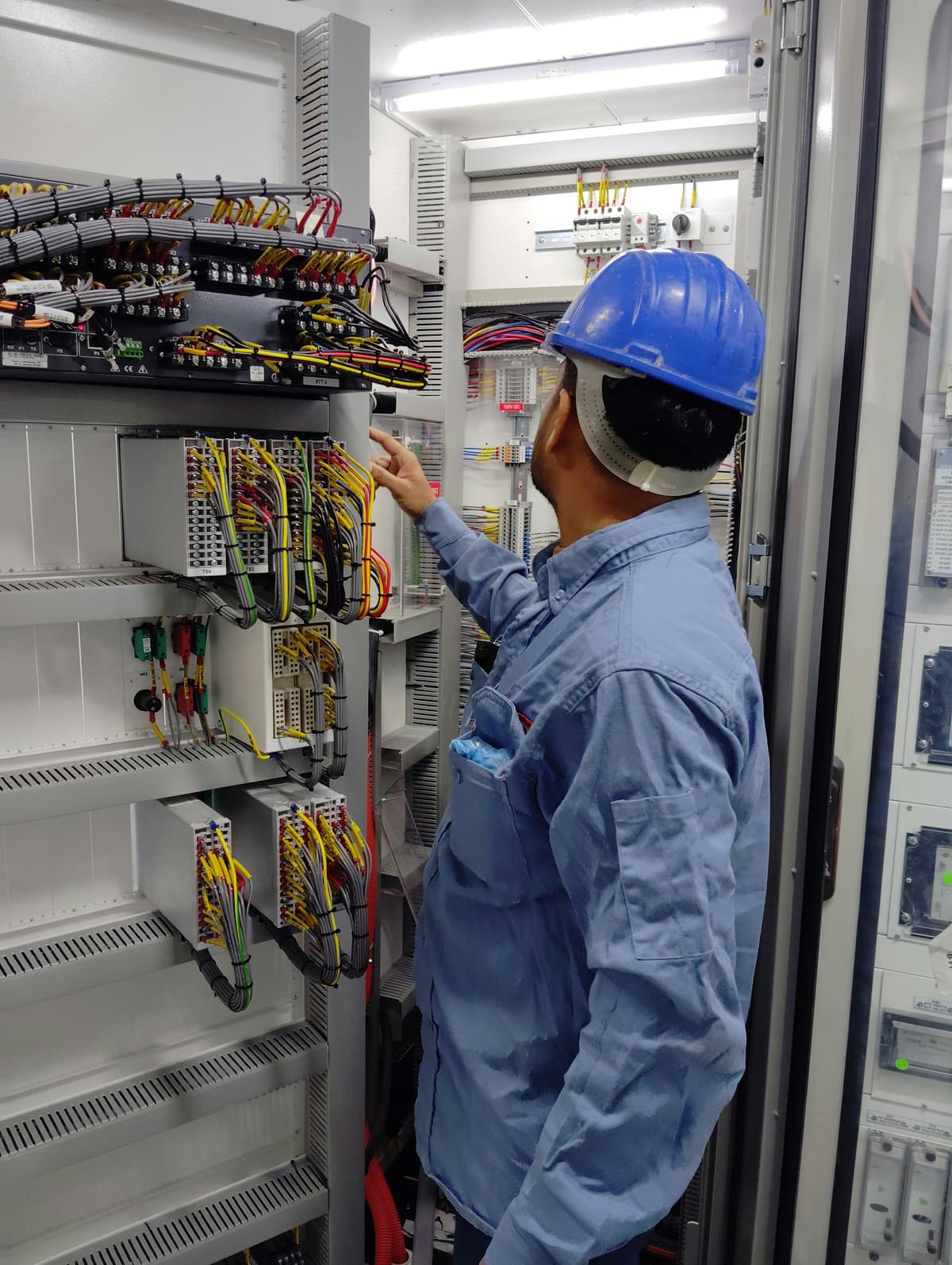
Industrial electrical control panels: actual uses in the plant and when to renew them
· by Panayot Dimkov
What is an industrial electrical control panel and why is it critical?
An industrial electrical control panel is the point where the power distribution, automation, and protection of a machine or process are concentrated. It is not "just a box with components": it is the place where it is decided whether a shutdown is orderly or chaotic, whether an alarm is diagnosed in minutes or hours, and whether an expansion is done with control or based on bridges and compromises.
In the plant, its value is noticed when something goes wrong. A well-designed panel limits damage, maintains traceability of the problem (clear signals, coordinated protections), and allows for safe intervention. An aging or "patched" panel does the opposite: it mixes standards, creates uncertainty, and turns any incident into an investigation.
Typical applications in industry
Machinery control (OEM and production lines)
In individual machines or stations, the panel usually integrates PLCs, 24 VDC power supplies, variable speed drives/servo drives, safety relays, I/O modules, and communications. Here, the priority is availability and repeatability: if the panel does not maintain electrical quality (noise, grounding, separations), intermittent faults appear that are difficult to reproduce: PLC resets, false inputs, drives failing due to EMC, sensors with erratic readings.
Process panels (pumps, valves, instrumentation)
In water treatment, chemical, food, or energy, the panel acts as a process node: interlocks, control loops, analog signals, industrial networks, and often integration with SCADA. Order and robustness are required. Poor shielding or a saturated terminal block is not just unsightly: it causes signal drift, noise in 4–20 mA, false levels, and incorrect control decisions.
Motor centers and power panels with integrated control
When the panel combines power (starters, motor protectors, drives) with control, protection coordination and thermal management come to the fore. Sustained overheating reduces the life of contacts, power supplies, and power electronics. At the operational level, the typical symptom is that "it works in the morning and starts to fail in the afternoon," especially in summer or with poor ventilation.
Retrofits and plant expansions
In expansions, the panel is where the price of past decisions is paid: lack of space, absence of documentation, no terminal reserves, saturated ducts, or improvised "star" networks. Many shutdowns due to expansions do not come from the software; they come from the panel, which does not allow changes without breaking something.
What's inside and what usually fails over the years
A standard control panel usually includes: main power supply and sectioning, protection (circuit breakers, fuses, residual current devices if applicable), 24 VDC power supplies, PLC and I/O, relays/contactors, functional safety (safety relays or PLCs), drives/servos if applicable, communications (industrial switch, gateways), terminals, grounding, ventilation, and signaling elements.
Actual failures over time are usually caused by:
- Thermal fatigue: loose terminals, degraded plastics, power supplies working at their limits.
- Contamination: conductive dust, oil mist, corrosive environments that attack contacts and copper.
- Obsolescence: impossible to find spare parts, old firmware without support, discontinued modules.
- Unplanned growth: additions without EMC criteria, without power and signal segregation.
- Reactive maintenance: replacing what burns out, not what is close to failing.
When does it make sense to renovate a panel: decision criteria in the plant
Renewal is not always "throw away and make new." Sometimes a well-planned partial update is enough. The decision is made based on technical and risk criteria.
Clear signs that the panel is no longer reliable
- Intermittent shutdowns with no obvious cause: different alarms, faults that disappear after resetting, recurring communication losses.
- Critical components that are hot or discolored: smell of overheating, darkened insulation, insufficient ventilation.
- Saturated and untraceable wiring: full conduits, illegible markings, internal splices, terminals without reserve.
- Protections "by eye": fuses replaced with higher values, oversized circuit breakers to prevent tripping.
- Lack of power/signal separation: analog and encoder cables next to motor cables or contactor outputs, without proper shielding.
- Misaligned documentation: diagrams that do not reflect reality, inconsistent I/O lists, uncontrolled changes.
- Operational obsolescence: a faulty module means days of downtime due to lack of spare parts or the need for "emergency engineering."
Service life: more than years, hours, and conditions
There is no universal figure. A panel can last 20 years in a clean environment with moderate load, and 6–8 years in a harsh environment with vibration and high temperature. Electronics (power supplies, drives, PLCs) age due to temperature and cycles. If the panel operates close to its thermal limit, its life is significantly shortened.
Cost of not renewing: the decisive argument
In industrial decisions, the real cost is downtime: line hours, scrap, restarts, on-call intervention, and lost production. If the criticality is high, renewing before failure is usually cheaper than maintaining a system with increasing breakdowns. A good indicator is the trend: if the number of electrical/automation incidents increases quarter after quarter, the panel is calling for structural intervention.
Total renewal vs. partial retrofit: how to choose
Total renovation (new panel)
This makes sense when there is profound obsolescence, disorderly growth, or electrical and functional safety issues. The architecture, segregation, and ventilation are redone, and the material is standardized. It is also used to leave real reserves: space, terminals, and power capacity.
Advantage: you reduce uncertainty and leave the system ready for 5–10 years of changes without "patches." Disadvantage: it requires planned downtime and well-managed commissioning.
Partial retrofit (selective upgrade)
Suitable if the mechanical base and field wiring are fine, but there are limiting elements: power supplies at their limit, unmanageable switches, obsolete PLCs, lack of functional safety, or drives without spare parts. Here, the criterion is to intervene where the risk is greatest without opening too many fronts.
The key is not to mix things up without control. If the PLC is changed, the power supply, protections, critical signals, and network must be checked. If drives are changed, check EMC, shielding, and grounding.
Common mistakes that cause recurring problems
"Adding one more component" without checking the power balance
More solenoid valves, more sensors, an extra HMI are added... and the 24 VDC power supply remains the same. Result: voltage drops, reboots, false inputs. Best practice: actual consumption calculation with margin, and divide loads (control, instrumentation, actuators) with separate protections and power supplies when appropriate.
Poor grounding and shielding management
Ground is not just a green/yellow wire. In panels with drives, servos, and analog signals, a poor ground reference or poorly terminated shielding causes phantom faults. Best practice: properly sized ground bus, shielding with criteria (proper termination according to signal), and physical segregation.
Ventilation treated as an accessory
Dense panels with drives and power supplies require thermal design: losses, forced ventilation, filters, and space around components. A "any old" fan without filter maintenance is a recipe for overheating and dust inside.
Uncoordinated protections and poor diagnostics
If everything trips "the general," diagnosis takes longer. Good practice: selectivity and reasonable coordination, protections by groups, and clear signaling of trips. In critical processes, 24 VDC monitoring and phase loss or overtemperature alarms provide real value.
Best practices that facilitate maintenance and future expansions
Internal standards and physical order
Channels with margin, consistent labeling, terminals with reserve and separation by function. It's not "pretty," but it reduces human error and intervention times.
Design oriented towards safe intervention
Clear sectioning, interlocks where applicable, accessibility for measurement, and separation of control power. Maintenance safety begins with the design of the panel.
Living documentation
Electrical diagrams, bill of materials, I/O list, network topology, and versioned changes. When documentation reflects reality, diagnosis time is drastically reduced. And planned shutdowns are no longer a gamble.
Testing before shutting down the plant
In renovations, the difference between a controlled project and chaos is pre-validation: panel FAT, critical signal simulation, network testing, and safety verification. In the plant, that translates into fewer commissioning hours and fewer surprises.
Quick signals in a field inspection
If you have to make a quick decision, three things provide a lot of information:
- Temperature and visual condition: hot spots, discoloration, odor, ventilation.
- Order and traceability: labeling, ducts, available and consistent diagrams.
- Failure history: intermittent failures, difficult spare parts, recovery times.
When two of these three are wrong, it is usually no longer a matter of "maintenance," but of renewal or retrofitting with discretion.
Are you unsure whether your control panel is at its limit or whether it should be redesigned to avoid unexpected downtime?
In industrial automation, there are no universal recipes: each installation requires a review of loads, criticality, spare parts, and actual plant conditions to ensure that the solution is robust and cost-effective.
If you have a project underway or a renovation pending, here you can see how we approach it and what information we need to get it off the ground.
Nexum Blog
Related articles

16 Oct 2026
Automating Processes in Line with the GDPR
How to automate processes in line with the GDPR: the five usual failures, Article 22, the processor agreement and a flow with no legal surprises.

9 Oct 2026
Mandatory B2B E-Invoicing in Spain: What to Do
Mandatory B2B e-invoicing in Spain now has its regulation: expected dates, how it differs from Verifactu and how to prepare while automating.

26 Jun 2026
BMS for industrial buildings: cost & grants
How much a BMS costs in an industrial building (€15,000–120,000) and which IDAE grants, Next Generation funds and CAE certificates can finance it.