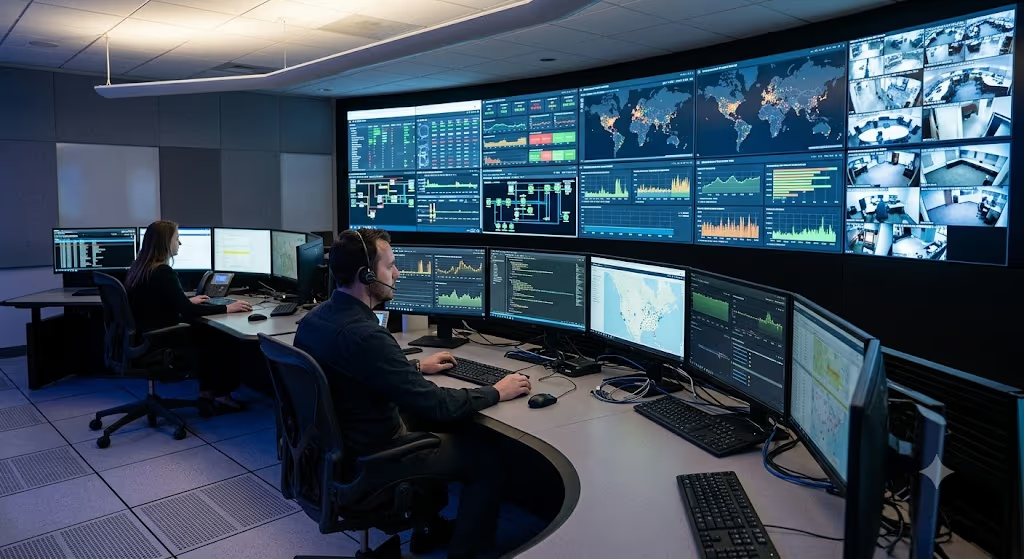
SCADA software: how to choose the right one for your plant
· by Panayot Dimkov
Choosing SCADA software is a decision your plant will live with for ten or fifteen years: it locks in licences, maintenance, integrations and even which engineers will be able to work with you. And yet many companies decide based on a sales brochure or on "what the plant next door uses". This guide collects the criteria we apply as system integrators — with no ties to any brand — so the choice is yours, not the vendor's.
Which SCADA software should you choose for your plant?
If you ask us point-blank, the honest answer from an integrator is: it depends on four factors, and until you have them on the table you shouldn't listen to any salesperson. Any of the serious platforms we'll review below can supervise your plant; the difference is what it will cost you to build it, maintain it and expand it.
Notice that none of the four factors is "which platform has the prettiest demo". All four belong to your plant, not to the product. That is why the right exercise starts with an inventory: count your signals, list your PLCs and fieldbuses, define how many operator stations you need and find out who can service you locally. With that done, half the options rule themselves out.
The main SCADA software families
The market is wide, but in practice industrial projects revolve around a handful of consolidated platforms. Neutral descriptions, no rankings: all of them run in thousands of plants and all of them can do the job if the project is framed properly.
| Platform | What it is | Where it fits naturally |
|---|---|---|
| Siemens WinCC / WinCC Unified | The SCADA of the Siemens ecosystem, integrated with TIA Portal. | Plants with a majority S7 PLC fleet that value unified hardware-software engineering. |
| AVEVA (Wonderware) InTouch / System Platform | A veteran of the sector, with a huge installed base and object-oriented architecture. | Process industries and multi-plant projects with corporate standards. |
| Ignition (Inductive Automation) | Platform licensed per server with unlimited tags and clients, web deployment. | New projects, plants with many visualisation stations and expected signal growth. |
| B&R APROL | Process control system integrated with B&R hardware. | Continuous and batch processes looking for DCS and SCADA in a single platform. |
| zenon (COPA-DATA) | Engineering platform with strong parameterisation instead of programming. | Energy, pharma and food & beverage, with demanding regulatory and logging requirements. |
The integrator's criteria (that the brochure doesn't mention)
When we at Nexum evaluate SCADA software for a client, we look at things far less glamorous than the demo screens. These are the ones that ultimately decide whether the project ages well or badly. We also ask who will use the system every day: how many operators, in which language, with what experience. A platform your team can be trained on quickly, with local courses and integrators, saves more money than any licence discount.
Per-tag vs unlimited licensing
It's the first question we ask. In per-tag models you pay by signal tiers (500, 5,000, 50,000...): if your plant is small and stable it can be economical; if it grows, every expansion reopens your wallet. In per-server models with unlimited tags and clients you pay more upfront, but adding signals or stations costs no extra licence. Neither is better in the abstract: project your tags 5-10 years ahead and run the numbers with both models before deciding.
Redundancy and historian
If a supervision outage costs you money, you need to know what each platform offers in redundancy (mirrored servers, automatic failover) and what licensing it costs, because in some models redundancy doubles the bill. Same with the historian: some platforms include it, others sell it as a separate module, others rely on standard databases. Always ask what it costs to store your history at the resolution you need — not the resolution of the demo.
Protocols: OPC-UA, Modbus, Profinet
A SCADA is only as good as its communications. Verify native support for OPC-UA — the open standard that makes you vendor-independent, maintained by the OPC Foundation — plus the fieldbuses already living in your plant: Modbus TCP/RTU, Profinet, EtherNet/IP. With a mixed PLC fleet, driver quality matters more than any screen feature: it's the difference between integrating in days or in weeks.
Cybersecurity and NIS2
The SCADA is the gateway between your OT network and the rest of the world, and with the NIS2 directive OT security has stopped being optional for many industries. Demand robust authentication, encrypted communications, role-based user management and a serious patching track record from the vendor. We cover this in depth in our guide on NIS2 and industrial OT cybersecurity: if your company falls within the directive's scope, this criterion becomes eliminatory.
Cloud or on-premise SCADA?
More and more platforms offer cloud or hybrid deployment. The decision is not about fashion but about your process:
| Criterion | On-premise | Cloud / hybrid |
|---|---|---|
| Real-time control | Yes, no internet dependency | Supervision only; critical control stays on site |
| Initial investment | Servers, perpetual licences | Lower entry, recurring fee |
| Multi-site access | Requires VPN and own infrastructure | Native, from any site |
| Cybersecurity | Under your control (and your responsibility) | Shared with the provider; check where data resides |
| Communications outage | The plant keeps operating as usual | Needs a local buffer to avoid losing data |
Our practical rule as integrators: control and the supervision production depends on stay on site; analytics, reporting and the corporate multi-site view go wherever they work out best — usually the cloud. Hybrids with a local historian and cloud aggregation are today's most common balance in mid-sized plants.
Total cost of ownership: what you'll really pay
The licence is only the tip of the iceberg. A complete SCADA project includes engineering (screens, communications, alarms, testing), servers and network, training, and the software's annual maintenance, which typically runs at 15-20% of the licence price. With that full picture, and as indicative ranges from real projects:
- Machine-level or small-process SCADA (one server, a few hundred tags): in the region of €15,000-30,000 for the complete project.
- Mid-sized plant SCADA (several thousand tags, historian, several stations): in the region of €30,000-80,000.
- Redundant or multi-plant SCADA (high availability, MES/ERP integration): from €80,000, frequently above €150,000.
Within these ranges, engineering usually outweighs the licence: it commonly accounts for half the budget or more. That is why two quotes for the same software can differ by tens of thousands of euros. We break down the line items and examples in how much a SCADA system costs; use it to read quotes critically before comparing.
One line item deserves its own mention: migration. If you are replacing an existing SCADA, budget for recreating screens, transferring the tag database and running both systems in parallel during changeover. Migrations rarely come in below a third of a new project, and they are the moment when the quality of your current documentation — or its absence — turns into money.
Typical mistakes when choosing SCADA software
We list them because we keep seeing them. Avoid these five and you're already choosing better than average:
- Choosing on the demo rather than the licensing model: the demo lasts an hour; the licence, fifteen years.
- Not projecting tags into the future: buying the exact signal tier and paying for the expansion at the price of someone who can't negotiate.
- Ignoring the real PLC fleet: a magnificent SCADA with mediocre drivers for your controllers is an expensive project.
- Forgetting who will maintain it: with no local integrators trained on that platform, every modification depends on a single supplier.
- Confusing SCADA with HMI and buying more (or less) than the process needs; we explain the difference in SCADA vs HMI.
Frequently asked questions
What is the best SCADA software?
There is no universal "best". The right choice depends on four factors of your plant: the number of tags to supervise, the existing PLC ecosystem, the licensing model you can afford and the local support available. Platforms like WinCC, AVEVA, Ignition, APROL or zenon can solve the same project with very different total costs depending on those factors.
What is the difference between per-tag and unlimited licensing?
With per-tag licences you pay by signal tiers, and every plant expansion may force you into a higher tier. With per-server models offering unlimited tags and clients you pay more upfront, but adding signals or stations costs no extra licence. To decide, project your tags 5-10 years ahead and calculate the total cost under both models.
Cloud SCADA or on-premise?
Real-time control and the supervision production depends on should reside on site, with no internet dependency. The cloud fits analytics, reporting and the corporate multi-plant view. Hybrid deployments — local historian with cloud aggregation — are today the most common balance in mid-sized plants.
How much does it cost to implement SCADA software?
As indicative complete-project ranges: €15,000-30,000 for a machine-level or small-process SCADA, €30,000-80,000 for a mid-sized plant with historian, and from €80,000 for redundant or multi-plant systems. Engineering usually accounts for half the budget or more, and annual maintenance runs at around 15-20% of the licence price.
The bottom line
Choosing SCADA software is not choosing a brand: it is taking stock of your tags, your PLC fleet, your ten-year budget and your support ecosystem, and letting those four factors rule options out for you. The "winning" platform is the one that minimises total cost of ownership in your specific plant, not the one that wins the feature comparison.
If you want a vendor-independent recommendation, see how we approach SCADA systems.
Torn between SCADA platforms?
Tell us how many signals you have, which PLCs run your plant and what you want to see. We'll propose the architecture and platform that fit best — with numbers, and with no brand commitment.
Talk to an expertNexum Blog
Related articles
8 Apr 2026
How to design an efficient production line
Learn how to design an efficient production line with the 6 key pillars: VSM, layout, balancing, integrated quality, flexibility and continuous improvement.
12 Aug 2026
Industrial control panel design: phases and costly mistakes
Industrial electrical panel design in 5 phases: specification, EPLAN schematics, thermal sizing, IEC 61439 and documentation. An integrator's guide.

5 Oct 2026
Power Automate Pricing and Premium Connectors
Power Automate pricing explained: what Premium, Process and Hosted Process cost, when premium connectors kick in and how to keep the bill under control.