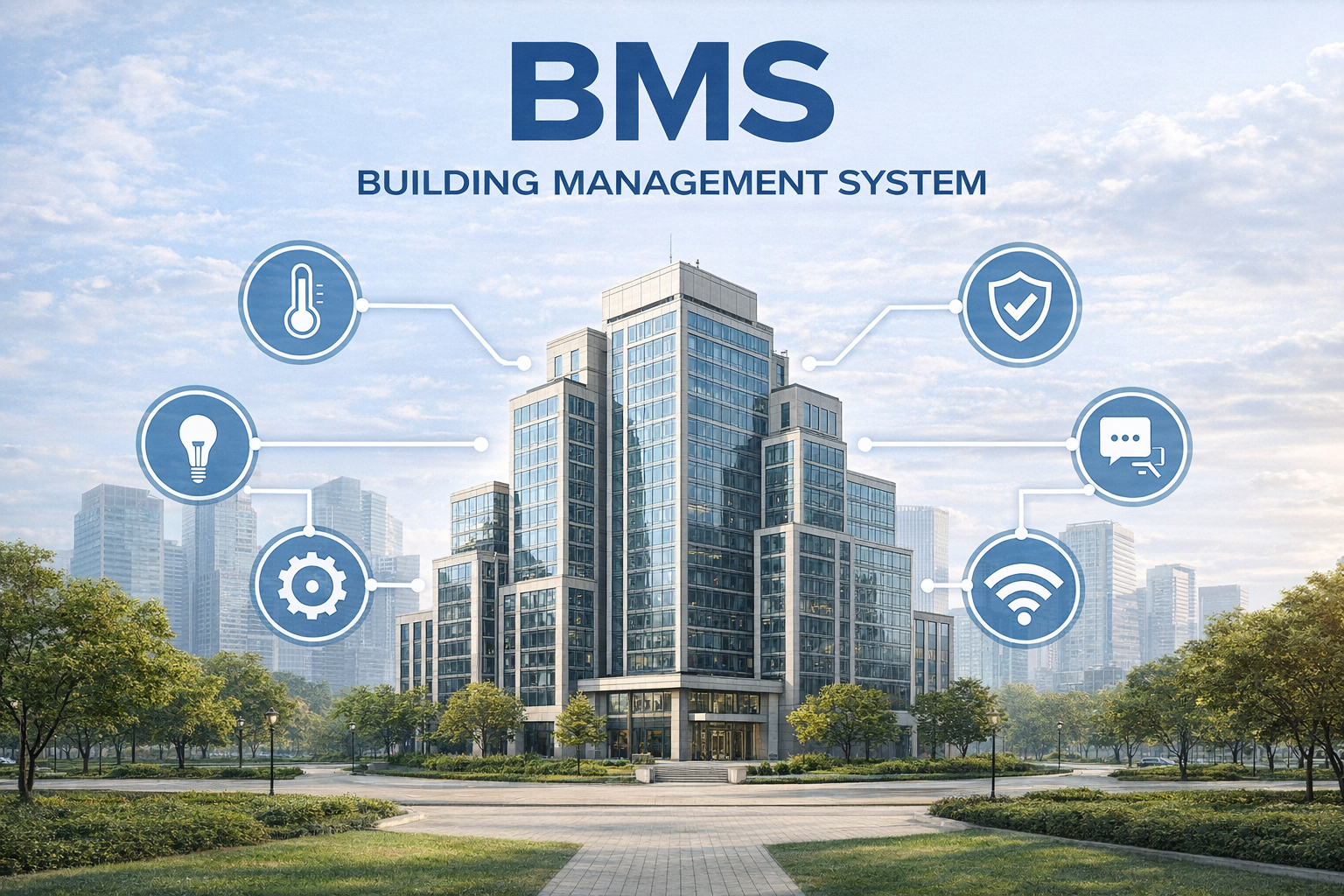
If you manage the maintenance of an office building, an industrial warehouse, or a data center, you’re probably familiar with the feeling: energy bills go up every year, HVAC systems run even when no one is there, and when something goes wrong, you find out too late. A BMS system exists precisely to solve these three problems. In this article, we explain what it is, how it works, and what you can expect in terms of real savings.
What is a BMS system?
BMS stands for Building Management System. It is a centralized platform that monitors, controls, and automates all of a building’s technical systems from a single point: heating, ventilation, and air conditioning (HVAC), lighting, ventilation, access control, fire detection, and electricity consumption.
Simply put: the BMS is the building’s brain. It receives continuous data from sensors distributed throughout the facility, analyzes it, and makes automatic decisions so that each system operates exactly when needed, at the required power level, and not a second longer.
It is also known as a BAS (Building Automation System), BACS, or centralized technical management system (GTC). In industrial environments, it is typically integrated with SCADA systems and PLCs to extend control to production processes.
How does a BMS work?
Its operation is based on three layers that work together:
1. Sensors and field devices Distributed throughout the building, they capture variables in real time: temperature, humidity, air quality, zone occupancy, consumption per circuit, and equipment status. They are the eyes and ears of the system.
2. Controllers process the information from the sensors and execute actions on the equipment: opening an HVAC valve, reducing light intensity, turning off ventilation in an unoccupied zone. In industrial facilities, these controllers are typically PLCs programmed with specific logic.
3. Management Software (SCADA / HMI) The central interface where the maintenance manager views the status of the entire facility in real time, configures alarms, analyzes consumption history, and generates reports. Accessible from a computer, tablet, or mobile device.
When these three elements work in coordination, the building stops operating on autopilot and begins to operate based on data.
What systems does a BMS control?
A BMS can integrate virtually any technical building system:
- Heating, Ventilation, and Air Conditioning (HVAC): control of boilers, chillers, air handling units, and fan coils. Scheduling by time and zone based on actual occupancy.
- Lighting: automatic on/off based on occupancy, dimming, and use of natural light.
- Ventilation: control of airflow based on indoor air quality (CO₂, VOCs) and occupancy.
- Electricity: consumption monitoring by circuit, detection of abnormal consumption, peak demand management.
- Security and access systems: integration with access control, CCTV, and intrusion detection.
- Fire detection and suppression: centralized monitoring and alarms.
- Renewable energy: in facilities with photovoltaic systems or storage, the BMS coordinates production, consumption, and battery charging to maximize self-consumption.
How much does a BMS actually save?
This is the question maintenance managers ask us most often before making a decision.
Industry data indicates savings of between 20% and 40% in energy consumption, depending on the building’s baseline and the integrated systems. In buildings with outdated or poorly managed systems, the return on investment can be achieved in 2 or 3 years.
Where do these savings come from? Mainly from three sources:
Eliminating phantom loads. Equipment running outside of operating hours, air-conditioned areas with no occupants, lights left on in empty rooms. A BMS automatically detects and corrects this waste, without anyone having to remember to turn anything off.
Optimize equipment startup and shutdown. HVAC systems don’t need to start up at the same time every day: it depends on the outdoor temperature, the building’s thermal inertia, and occupancy forecasts. A BMS calculates the optimal start time to ensure the correct temperature is reached just as people arrive, without overheating or overcooling.
Predictive maintenance. The system detects anomalies before they turn into breakdowns: a pump consuming more than normal, a sensor giving out-of-range readings, or equipment failing to respond to commands. This reduces unplanned downtime and extends the equipment’s service life.
In what types of facilities does it make the most sense?
A BMS adds value in any facility where energy consumption is significant and manual management is inefficient. Some cases where the impact is particularly high:
- Industrial and production facilities with multiple zones, variable shifts, and high-energy-consumption equipment
- Data centers and server rooms where climate control is critical and continuous
- Office buildings with variable occupancy throughout the day
- Hotels and shopping centers with high occupancy variability and comfort requirements
- Hospitals and healthcare facilities where temperature and air quality control are critical
What sets a well-implemented BMS apart from one that doesn’t work?
Many facilities have a BMS that nobody uses, or that only monitors without taking action. The difference between a system that generates real savings and one that is just a pretty dashboard lies in:
- True integration with all systems. A BMS that only controls HVAC leaves much of the savings potential untapped.
- Proper configuration. Setpoints, schedules, and alarm thresholds must be adjusted to the building’s actual usage; they should not be left at factory defaults.
- Maintenance and continuous updates. A BMS is a living system: usage patterns change, equipment ages, and regulations evolve.
- Training the maintenance team. The system may be excellent, but if no one knows how to interpret it or act on its data, the savings will not materialize.
Conclusion
A well-implemented BMS is not a technological expense: it is an investment with a measurable return, which reduces energy bills, extends the life of equipment, and prepares the facility to comply with upcoming regulations.
The key lies in choosing the right system for each facility and configuring it correctly from day one—a process that requires technical expertise in both automation and the specific characteristics of each building type.
Are you considering installing a BMS system in your building or industrial facility?
At Nexum Automatics, we have years of experience programming and integrating BMS systems in industrial and service environments. We analyze your facility, tell you what savings you can expect, and design a solution tailored to your actual needs.
Request a free consultation—no obligation—with a preliminary technical analysis of your facility.